Foundry Sea to Sky now offering interim services
Foundry PhD research trainee receives prestigious Clyde Hertzman Memorial Fellowship
On August 31, 2022, Katherine (Katie) Hastings, a UBC doctoral student was named the successful recipient of the 2nd annual ‘Society to Cell’ Clyde Hertzman Memorial Fellowship for her research project, “How has the mental health service needs of youth in BC changed since the pandemic: a retrospective analysis using data from a province-wide integrated youth service network“.
The ‘Society to Cell’ Clyde Hertzman Memorial Fellowship financially supports UBC trainees who are conducting research projects that will enrich our understanding of the impact of social and environmental factors on health and well-being across the life course.
For Dr. Skye Barbic, Head Scientist at Foundry, this scholarship honours the legacy of Dr. Hertzman – who passed away suddenly in February 2013 – as a world-leading researcher in the social determinants of health, a champion for social justice, and a tireless advocate for youth.
“We are so proud of Katie’s work to date,” says Dr. Barbic, “and look forward to partnering with her and Dr. Anne Gadermann from the UBC School of Public and Population Health to advance this impactful research and support Katie’s trajectory as a future health service leader, educator, and researcher.
Learn more about her project below:
How has the mental health service needs of youth in BC changed since the pandemic: a retrospective analysis using data from a province-wide integrated youth service network
Canada and many parts of the world are investing in an emerging model of care called Integrated Youth Services (IYS), combining a blend of traditional (psychiatric care, counseling) and non-traditional services (peer support, primary care, and social services) delivered in a singular, accessible and youth-friendly location. This comes at a critical time in which youth are facing unprecedented levels of social isolation and missing important developmental milestones with school closures, quarantine orders, and increased family and individual stress due to the pandemic.
The overall aim of this study is to understand the impact of integrated youth services (IYS) on access and service utilization patterns among diverse youth in BC, by describing characteristics and predictors of service utilization among youth accessing IYS; comparing temporal trends of service use and mental health outcomes of youth accessing services by IYS sites over time (2018-2022); and comparing overall service utilization patterns (i.e., any mental health-related services accessed in BC) of youth before and after an initial visit at an IYS.
With widening socioeconomic and health inequities, understanding the impact of Foundry, an IYS established in 2015, and the needs of diverse youth in BC will help inform rapid policy and public health action to address these disparities.
“Being awarded this fellowship means a lot to me,” says Katie. “Dr. Clyde Hertzman has left a huge legacy in the field of early childhood development and I hope to honor his vision to explore ‘differences that make a difference’ through this work.”
“We have a unique opportunity to examine the mental health landscape and service needs of youth through the rich data sources available at Foundry. Findings from this study can be used to identify potential gaps in access and services needed to address the increasing mental health burden among youth brought on by the pandemic.”
Congratulations to Katie on this award!
Clyde Hertzman Memorial Fellowship Award, UBC researcher, Dr. Skye Barbic, Skye Barbic, Foundry BC, Foundry, the Foundry, integrated youth services, foundry counselling, youth mental health, translated mental health services, kids mental health, free counselling, youth support, teenager mental health support, youth programs, mental health and addictions
Two Foundry teams funded through PHC’s annual Practice-based Research Challenge
On Aug 23, two Foundry Vancouver-Granville teams were among the 15 successful teams receiving funding through the annual PHC Practice-based Research Challenge, for their research project: Experiences of Indigenous youth accessing mental health care through primary care and psychiatry at two inner-city integrative community health centres.
The Research Challenge is a competition open to point-of-care PHC staff and offers research teams the opportunity to work with a mentor to develop a research proposal around a research question, where they learn basic research skills and compete with other teams for funding to conduct a small-scale research project.
Presentations were judged by a panel comprised of scientific and Patient and Family Partner reviewers.
Winning teams receive up to $5,000 each in research award funding to conduct their research over an 18-month period.
Learn more about their project below:
Experiences of Indigenous youth accessing mental health care through primary care and psychiatry at two inner-city integrative community health centres.
Team members:
- Janae Dunlop RN
- Lyn Heinemann OT
- Emily Leake NP
- Sarah Cochrane NP
- Courteney Durand PFP
Young people aged 15–24 are more likely to experience mental health and/or substance use disorders than any other age group. As a result of the negative impacts of colonization, cultural oppression and historical trauma, Indigenous youth experience a disproportionate burden of mental health and substance use concerns with even more barriers to accessing care than non-Indigenous youth. Primary care and mental health services in urban settings have generally not been adapted to serve the needs of Indigenous young people.
The aim of this project is to gain an understanding of the experiences of Indigenous youth ages 16-24 years who have accessed mental health care through primary care and psychiatry at two urban health centres. Findings may help service providers optimize the care outcomes and experiences of urban Indigenous youth and directions for future research.
What is the experience of youth transitioning from Foundry youth services to adult care?
Team members:
- Farzana Rayani – Nurse Practitioner
- Chelsea Stratton – Rehab Assistant
- Ingrid Mayer – Patient Family Partner
- Danielle O’Callaghan – Patient Partner
Our research project will look at the experience of youth transitioning from Foundry integrative youth services to adult care, or independence. Foundry is a community-based youth (age 16-25 years) mental health and substance use clinic. Foundry Services are comprehensive and offer mental health care, substance use services, primary care, social services, and youth and family peer supports.
Due to this “one stop shop” approach to care, our clinic is heavily involved in many aspects of a client’s life until they turn 25. There is currently no transition pathway or plan in place that Foundry clinicians can use to guide clients through the ageing out process.
To explore this transition period, we will complete a qualitative research study using interviews and focus groups with former Foundry clients to identify the ways their health, and overall wellbeing has changed since ageing out of Foundry care. Our goal is to use the information gathered and to develop a pathway Foundry can use to better support and prepare our clients as they transition out of our care.
Foundry Vancouver-Granville is part of the Foundry network, a growing provincial and national network that includes over 200 partnerships. It also serves as one of 12 Foundry centres across BC that provides free and confidential health and wellness services for young people ages 12-24.
“The Foundry Network is a Learning Health System,” says Dr. Skye Barbic, Head Scientist, Foundry. “The Research Challenge is an opportunity to create, acquire, and transfer new knowledge from one centre and share insights with partner organizations in Vancouver and across the entire Foundry network.
“The success of these teams shows incredible commitment from service providers at Foundry Vancouver Granville. We are grateful to their commitment to generate and share evidence to improve the outcomes and experience of youth and families.”
Congratulations to Janae Dunlop, Lyn Heinemann, Emily Leake, Sarah Cochrane, Courteney Durand, Farzana Rayani, Chelsea Stratton, Ingrid Mayer, Danielle O’Callaghan on this award!
PHC research challenge, PHC, Providence Health Care, Foundry Vancouver-Granville, UBC researcher, Dr. Skye Barbic, Skye Barbic, Foundry BC, Foundry, the Foundry, integrated youth services, foundry counselling, youth mental health, translated mental health services, kids mental health, free counselling, youth support, teenager mental health support, youth programs, mental health and addictions
Foundry Surrey Secures a Location
Foundry is coming to Fort St.John
Foundry Comox Valley opens it doors to young people
Foundry BC receives 2021 Premier’s Award for Innovation
On December 8th, BC Public Services named Foundry BC as the recipient of the 2021 Premier’s Award for Innovation, which recognizes groups, teams or organizations in the BC Public Service who have developed and transformed new ideas into tangible initiatives, programs or projects.
Now, more than ever, we know that young people are in need of support.
Since the launch of A Pathway to Hope in 2019 by the Ministry of Mental Health and Addictions to ensure better access to mental health and substance use for people in BC, more than 12,000 youth accessed Foundry services in more than 90,000 visits. We are thankful Foundry was nominated for this award by our partners in government, and excited to share this acknowledgement with everyone in our network.
“Foundry is a really great example of innovation in the public service because… it’s a model built for youth by youth,” says Nick Grant, Assistant Deputy Minister.
Foundry BC is incredibly honoured to be part of this annual celebration which highlights the finest examples of innovation and excellence in the BC Public Service. Thank you to all Foundry centres and networks across the province who are instrumental in this achievement, as we continue our mission in reaching younger people early and address smaller problems before they become bigger ones.
To learn more, watch the video below.
Visit foundrybc.ca or Foundry Virtual BC to learn more about our services.
Keywords:
BC Public Service, Foundry BC, Foundry Virtual BC, 2021 Premier’s Award for Innovation, Award, Mental Health, Public Service, Youth, Youth Services, British Columbia, Support, Youth Support, Support Services, Provincial Services, BC, Nick Grant, Dr. Steve Mathias, Peer Support, Counselling, Caregivers, Parents, Innovation, Substance Use, A Pathway to Hope, Ministry of Mental Heath and Addictions, Michael Smith Health Research BC, Providence Health Care, St. Paul’s Foundation
Learnings from the first year of Foundry Virtual BC
Since the COVID-19 pandemic began, many children and youth in BC are experiencing increased anxiety, stress and other mental health challenges. Foundry has worked quickly to implement innovative virtual solutions for youth and families/caregivers living in BC (learn more in this overview of Foundry’s COVID-19 response to date).
Last spring, we launched virtual services using interim technology, and in early April 2020, Foundry Virtual BC began offering services to young people and families/caregivers across the province through the Foundry BC app, which was co-created with and for youth.
The app offers a user-friendly, accessible way to schedule virtual counselling and peer support appointments in advance, as well as access same-day support via messaging, audio or video sessions, peer group sessions, and web-based tools and resources. No referrals or assessments required.
Here are some of our learnings one year later (taken from Frayme’s report):
- Foundry’s provincial virtual service filled a gap for youth and their families/caregivers who otherwise may not have accessed services.
- The soft launch of the Foundry BC app has already changed the way youth and families/caregivers access services virtually in BC.
- Breaking down barriers to access and advancements in technology have led to increased youth engagement with Foundry Virtual BC.
- With the rapid launch of Foundry Virtual BC, youth in BC have been able to access multiple services to address their needs and improve their outcomes.
- Foundry’s provincial virtual service is reaching high risk and high-needs youth across BC.
- BC youth and families/caregivers are having positive experiences with Foundry Virtual BC technology, services and staff.
- Foundry’s provincial virtual service team has gained valuable insight for quality improvement opportunities and innovations in virtual care.
Since launching virtual services, Foundry has received positive feedback from youth.
“My peer supporter really knows me by now and is able to make really personalized suggestions.”
“I was diagnosed with a disorder that now allows me to begin receiving treatment.”
“It allowed me to talk about how I was feeling, ask for coping mechanisms, and say personal things.”
Foundry Virtual BC offers virtual counselling sessions by voice, video and chat (including booked appointments and walk-ins); peer support (including one-on-one services and peer lead groups); and groups and workshops for young people and their families/caregivers.
The Foundry BC app is available through the Apple Store, Google Play store or on desktop through a web portal.
To learn more and access services, visit foundrybc.ca/virtual.
Keywords: mental health, anxiety, stress, peer support, counselling
Foundry featured in the Mental Health Commission of Canada report
Recently, the Mental Health Commission of Canada issued a report featuring eight unique case studies designed to support health-care and wellness organizations in implementing a recovery-oriented practice.
Foundry was honoured to be one of several organizations highlighted in this report, and to share our approach to this practice which centres the voices and perspectives of youth and their families.
As Foundry’s Head Scientist Dr Skye Barbic said: “Foundry is about co-designing new possibilities in youth services. It’s no longer about bringing youth to the table but building the table that will allow them to fully participate and lead the way.”
Congratulations to our peers at AQRP, CHANNAL, CMHA Calgary, Ontario Shores, Peer Connections Manitoba, Phoenix Residential Society and Reach Out Centre for Kids for their outstanding work in this area as well.
To read the report, click here.
Discovering Beauty of Life In Psychosis (BLIP)
About the authors
Rory (they/them) is a non-binary artist, peer support worker, and researcher with lived/living experience of psychosis. They are also a facilitator and administrator for the BC Hearing Voices Network, and their writing on the Hearing Voices Movement recently appeared in Health and Human Rights Journal.
Beauty of Life in Psychosis
Rory and Anne, have had the pleasure of developing the Beauty of Life in Psychosis (BLIP) group, nurturing it through its infancy, and facilitating the first ever cohort over the last 3 months. It has been an amazing experience getting to know our peers in the group, whom have all brought with them a plethora of skills, experiences, stories, talents and creative ideas.
Breakthrough symptoms or relapse of psychosis are sometimes referred to as “blips.” But what is a blip, anyway? Colloquially, a blip is a minor, short-term change, like a small dip or spike on a graph. “BLIPS,” on the other hand, is a medical term that stands for “Brief Limited Intermittent Psychotic Symptoms.” Foundry’s provincial virtual services offers a youth group called BLIP using our own definition: Beauty of Life in Psychosis.
Sometimes, psychosis is talked about in stigmatizing ways that make people feel like they are broken, abnormal, or “crazy.” Foundry Virtual BC hopes to reclaim the word “blip” to mean something that- while can be frightening or upsetting– can also be a common, experience. Psychosis is complicated, and we believe it’s important to be able to speak openly about what it means for each of us individually – the good, the bad, and the beautiful! Through art and creativity, we hope to build a sense of connection and community, explore the personal meaning of our experiences, and celebrate ourselves as whole people with a unique, beautiful perspective to contribute to the world.
The BLIP youth group was born out of the idea that people who experience psychosis, hear voices, see visions, and/or have unique beliefs need a safe(r) space to socialize, get creative, and express ourselves. Our goal is to encourage participants to find beauty, hope, and community within or around these experiences. With support from Foundry Virtual BC and Vancouver Coastal Health’s Consumer Initiative Fund, that idea became a reality. Using these funds, we were able to collaborate with Paint Spot and provide free art supplies for everyone in the group.
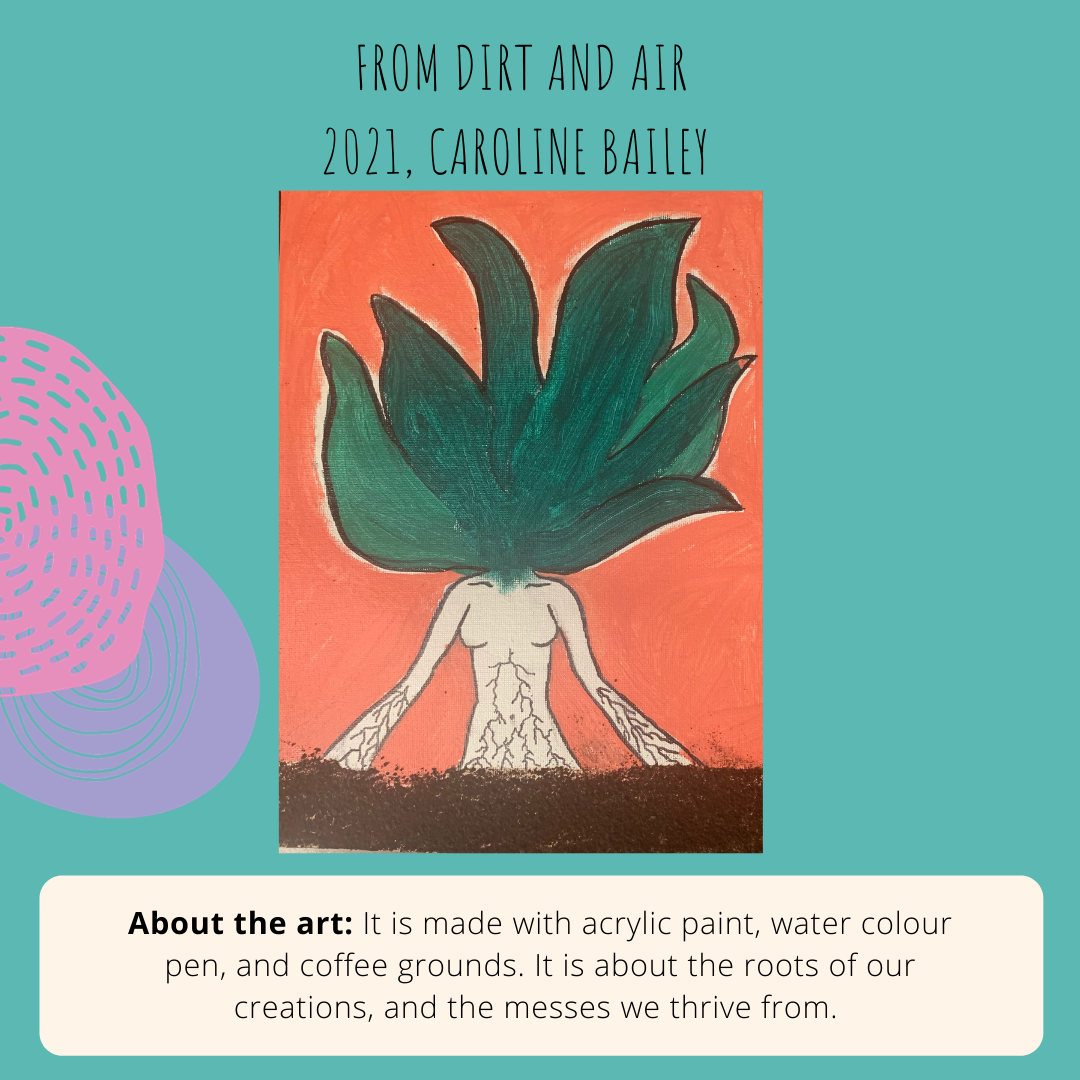
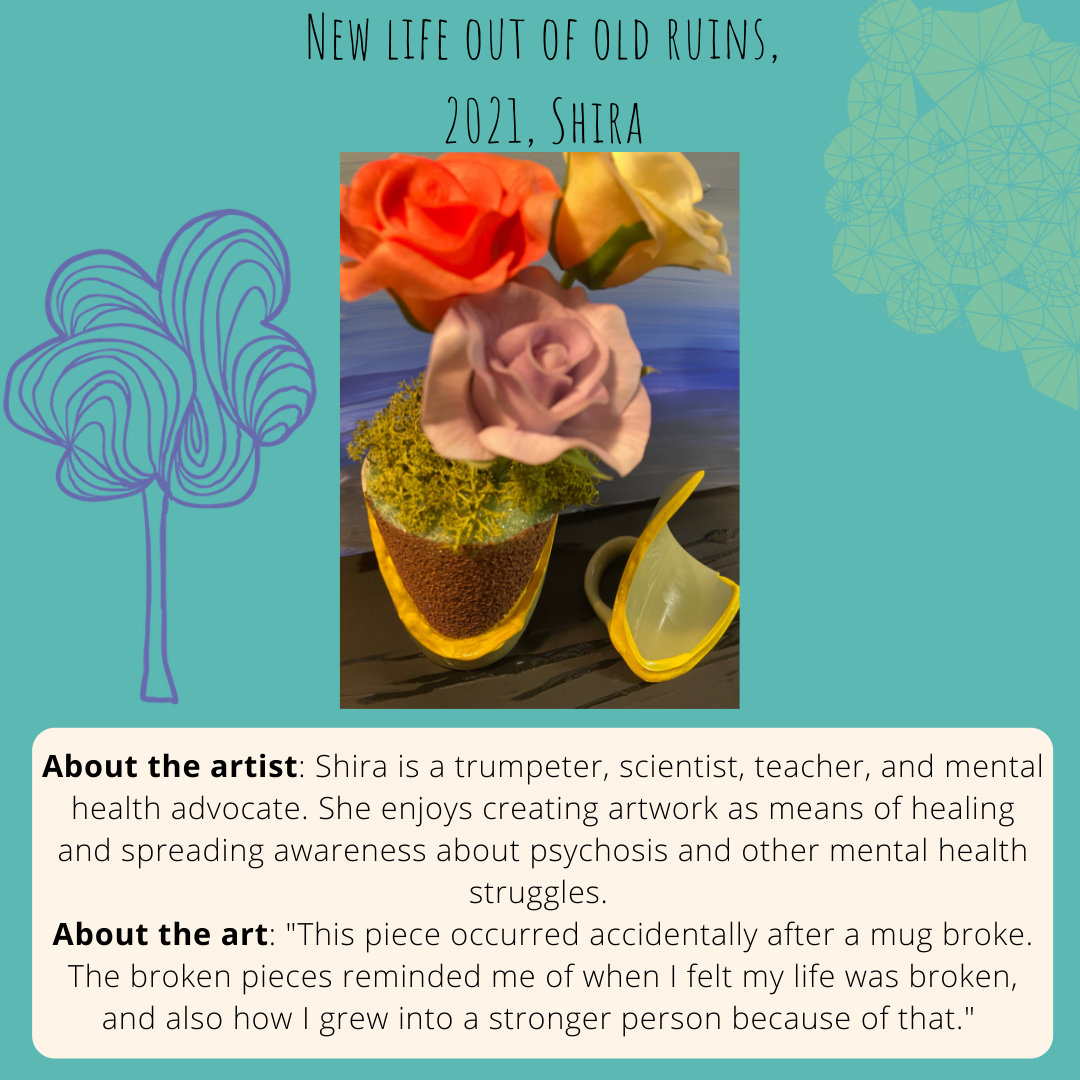
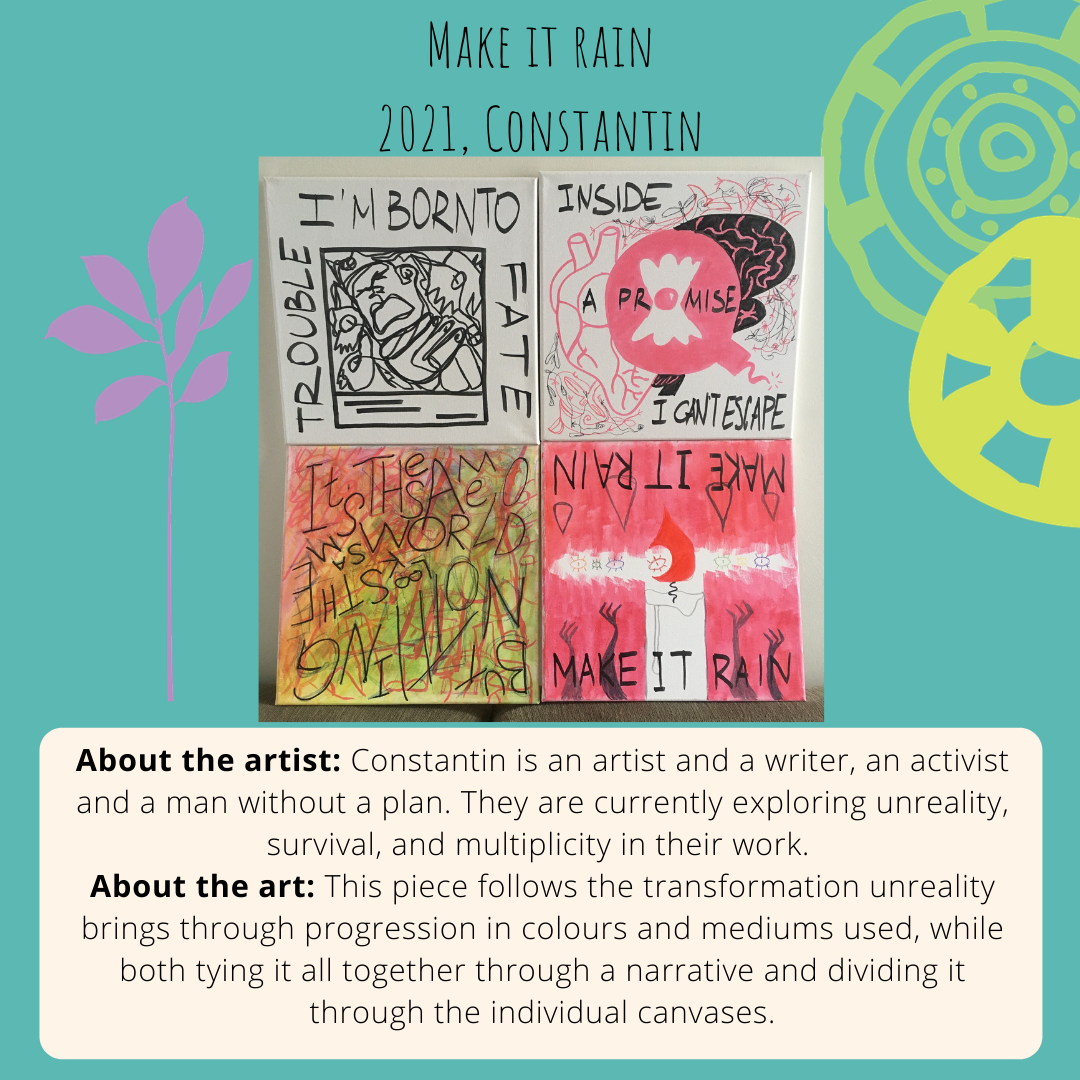
We started each session with a short, guided exercise surrounding a specific theme. Over the course of 6 sessions, we explored self-expression, colour, movement, texture, light & dark, and lastly, space. During the final few sessions, we discussed our ideas for the final project as a group, and the theme we settled on was “transformation.” We spoke about journaling our experiences and growing through that process; imagining and pursuing futures for ourselves that we were told not to expect, the transformation of our self-perception throughout our journeys; and how media portrayals can “transform” our experiences and identities in stigmatizing ways. In that sense, we talked about both negative and positive transformations. Sub-themes of renewal, growth, uncertainty, healing, and the shattering (and rebuilding) of identity emerged.
We are thrilled to share the artwork created with the first cohort of the BLIP youth group. Click on images to expand!
To learn more about future offerings of BLIP, or to learn more about groups offered by Foundry’s provincial virtual services, please visit foundrybc.ca/virtual/youth-groups.
To learn more about psychosis read the Questioning Reality section of our website or take the Questioning Reality Self-Check. If you would like to reach out to Foundry for support, reach out to Foundry’s provincial virtual services or visit a Foundry centre near you.