Foundry PhD research trainee receives prestigious Clyde Hertzman Memorial Fellowship
On August 31, 2022, Katherine (Katie) Hastings, a UBC doctoral student was named the successful recipient of the 2nd annual ‘Society to Cell’ Clyde Hertzman Memorial Fellowship for her research project, “How has the mental health service needs of youth in BC changed since the pandemic: a retrospective analysis using data from a province-wide integrated youth service network“.
The ‘Society to Cell’ Clyde Hertzman Memorial Fellowship financially supports UBC trainees who are conducting research projects that will enrich our understanding of the impact of social and environmental factors on health and well-being across the life course.
For Dr. Skye Barbic, Head Scientist at Foundry, this scholarship honours the legacy of Dr. Hertzman – who passed away suddenly in February 2013 – as a world-leading researcher in the social determinants of health, a champion for social justice, and a tireless advocate for youth.
“We are so proud of Katie’s work to date,” says Dr. Barbic, “and look forward to partnering with her and Dr. Anne Gadermann from the UBC School of Public and Population Health to advance this impactful research and support Katie’s trajectory as a future health service leader, educator, and researcher.
Learn more about her project below:
How has the mental health service needs of youth in BC changed since the pandemic: a retrospective analysis using data from a province-wide integrated youth service network
Canada and many parts of the world are investing in an emerging model of care called Integrated Youth Services (IYS), combining a blend of traditional (psychiatric care, counseling) and non-traditional services (peer support, primary care, and social services) delivered in a singular, accessible and youth-friendly location. This comes at a critical time in which youth are facing unprecedented levels of social isolation and missing important developmental milestones with school closures, quarantine orders, and increased family and individual stress due to the pandemic.
The overall aim of this study is to understand the impact of integrated youth services (IYS) on access and service utilization patterns among diverse youth in BC, by describing characteristics and predictors of service utilization among youth accessing IYS; comparing temporal trends of service use and mental health outcomes of youth accessing services by IYS sites over time (2018-2022); and comparing overall service utilization patterns (i.e., any mental health-related services accessed in BC) of youth before and after an initial visit at an IYS.
With widening socioeconomic and health inequities, understanding the impact of Foundry, an IYS established in 2015, and the needs of diverse youth in BC will help inform rapid policy and public health action to address these disparities.
“Being awarded this fellowship means a lot to me,” says Katie. “Dr. Clyde Hertzman has left a huge legacy in the field of early childhood development and I hope to honor his vision to explore ‘differences that make a difference’ through this work.”
“We have a unique opportunity to examine the mental health landscape and service needs of youth through the rich data sources available at Foundry. Findings from this study can be used to identify potential gaps in access and services needed to address the increasing mental health burden among youth brought on by the pandemic.”
Congratulations to Katie on this award!
Clyde Hertzman Memorial Fellowship Award, UBC researcher, Dr. Skye Barbic, Skye Barbic, Foundry BC, Foundry, the Foundry, integrated youth services, foundry counselling, youth mental health, translated mental health services, kids mental health, free counselling, youth support, teenager mental health support, youth programs, mental health and addictions
Two Foundry teams funded through PHC’s annual Practice-based Research Challenge
On Aug 23, two Foundry Vancouver-Granville teams were among the 15 successful teams receiving funding through the annual PHC Practice-based Research Challenge, for their research project: Experiences of Indigenous youth accessing mental health care through primary care and psychiatry at two inner-city integrative community health centres.
The Research Challenge is a competition open to point-of-care PHC staff and offers research teams the opportunity to work with a mentor to develop a research proposal around a research question, where they learn basic research skills and compete with other teams for funding to conduct a small-scale research project.
Presentations were judged by a panel comprised of scientific and Patient and Family Partner reviewers.
Winning teams receive up to $5,000 each in research award funding to conduct their research over an 18-month period.
Learn more about their project below:
Experiences of Indigenous youth accessing mental health care through primary care and psychiatry at two inner-city integrative community health centres.
Team members:
- Janae Dunlop RN
- Lyn Heinemann OT
- Emily Leake NP
- Sarah Cochrane NP
- Courteney Durand PFP
Young people aged 15–24 are more likely to experience mental health and/or substance use disorders than any other age group. As a result of the negative impacts of colonization, cultural oppression and historical trauma, Indigenous youth experience a disproportionate burden of mental health and substance use concerns with even more barriers to accessing care than non-Indigenous youth. Primary care and mental health services in urban settings have generally not been adapted to serve the needs of Indigenous young people.
The aim of this project is to gain an understanding of the experiences of Indigenous youth ages 16-24 years who have accessed mental health care through primary care and psychiatry at two urban health centres. Findings may help service providers optimize the care outcomes and experiences of urban Indigenous youth and directions for future research.
What is the experience of youth transitioning from Foundry youth services to adult care?
Team members:
- Farzana Rayani – Nurse Practitioner
- Chelsea Stratton – Rehab Assistant
- Ingrid Mayer – Patient Family Partner
- Danielle O’Callaghan – Patient Partner
Our research project will look at the experience of youth transitioning from Foundry integrative youth services to adult care, or independence. Foundry is a community-based youth (age 16-25 years) mental health and substance use clinic. Foundry Services are comprehensive and offer mental health care, substance use services, primary care, social services, and youth and family peer supports.
Due to this “one stop shop” approach to care, our clinic is heavily involved in many aspects of a client’s life until they turn 25. There is currently no transition pathway or plan in place that Foundry clinicians can use to guide clients through the ageing out process.
To explore this transition period, we will complete a qualitative research study using interviews and focus groups with former Foundry clients to identify the ways their health, and overall wellbeing has changed since ageing out of Foundry care. Our goal is to use the information gathered and to develop a pathway Foundry can use to better support and prepare our clients as they transition out of our care.
Foundry Vancouver-Granville is part of the Foundry network, a growing provincial and national network that includes over 200 partnerships. It also serves as one of 12 Foundry centres across BC that provides free and confidential health and wellness services for young people ages 12-24.
“The Foundry Network is a Learning Health System,” says Dr. Skye Barbic, Head Scientist, Foundry. “The Research Challenge is an opportunity to create, acquire, and transfer new knowledge from one centre and share insights with partner organizations in Vancouver and across the entire Foundry network.
“The success of these teams shows incredible commitment from service providers at Foundry Vancouver Granville. We are grateful to their commitment to generate and share evidence to improve the outcomes and experience of youth and families.”
Congratulations to Janae Dunlop, Lyn Heinemann, Emily Leake, Sarah Cochrane, Courteney Durand, Farzana Rayani, Chelsea Stratton, Ingrid Mayer, Danielle O’Callaghan on this award!
PHC research challenge, PHC, Providence Health Care, Foundry Vancouver-Granville, UBC researcher, Dr. Skye Barbic, Skye Barbic, Foundry BC, Foundry, the Foundry, integrated youth services, foundry counselling, youth mental health, translated mental health services, kids mental health, free counselling, youth support, teenager mental health support, youth programs, mental health and addictions
Foundry’s research team receives Convening and Collaborating award from Michael Smith Health Research BC
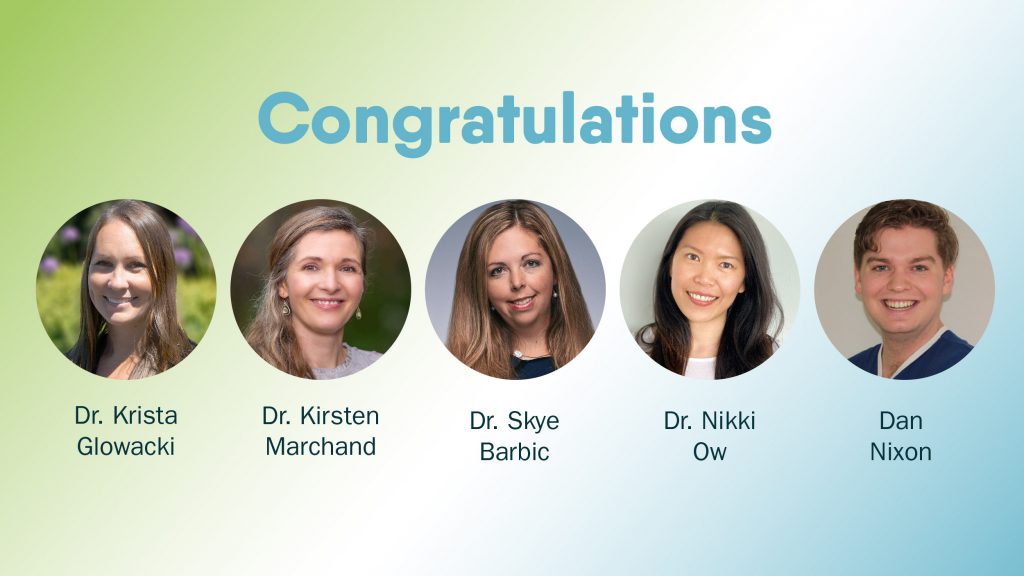
On September 29th, 2021, the Michael Smith Health Research BC (Health Research BC) named Dan Nixon (Youth Peer Engagement Coordinator, Foundry BC), Dr. Kirsten Marchand, Dr. Krista Glowacki, Dr. Nikki Ow, Dr. Skye Barbic (Director of Research, Foundry BC) and their team among the 32 recipients receiving the 2021 Convening and Collaborating (C2) award for their project: Sharing the podium: identifying solutions to meaningfully collaborate with youth in mental health and substance use research. This project will engage key stakeholders in co-creating a set of recommendations to improve youth engagement and collaboration in mental health and substance use (MHSU) research.
Foundry is thrilled to be part of this announcement which comes two weeks following the announcement of Dr. Kirsten Marchand and Dr. Krista Glowacki, as recipients of Health Research BC’s Research Trainee award. This marks the first time that Foundry has been honoured with two Health Research BC awards in the same year.
“Since day 1, Health Research BC has been there to support Foundry. Through various programs, Health Research BC’s support allows us to build a network of academic, clinical, and youth leaders who are driving service innovation in BC for young people and families,” says Dr. Skye Barbic, Director of Research, Foundry and 3x Health Research BC awardee.
The Health Research BC’s C2 program promotes knowledge exchange and meaningful collaboration by supporting researchers, trainees and research users (those with lived experience) in co-developing research that can have a direct impact on patients and the public.
Learn more about their project below:
Mental health and substance use (MHSU) are key health concerns for youth in British Columbia. Involving youth in research for these topics improves the development of MHSU interventions and solutions. However, youth may not want to engage in MHSU research due to concerns around confidentiality, stigma, and other barriers. Researchers may also perceive barriers in finding and working with youth researchers.
The main goal of this project is to identify barriers for youth engagement in MHSU research and recommend solutions for these issues. Two key activities – a small-group discussion (utilizing nominal group technique) and a World Café in-person (March-May 2022, pending COVID-19 restrictions) – will be used to bring youth and researchers together to identify the perceived barriers for each group and how these barriers can be overcome.
From these findings, Foundry’s research team will synthesize results and outline a list of recommendations for youth engagement in MHSU research, and pursue additional funding for a pilot study using these recommendations. The pilot study will measure changes in youth research engagement and research outcomes due to the recommendations.
Foundry’s second award recognition in 2021
Youth engagement, research collaborations and co-design is central to our work at Foundry. We are deeply grateful to Health Research BC for their continuous support in enabling our researchers to lead this innovative work.
Congratulations to Dan Nixon, Dr. Kirsten Marchand, Dr. Krista Glowacki, Dr. Nikki Ow, Dr. Skye Barbic and their team on this award!
Special thanks to our partner and host institutions for making this possible: BC Centre for Disease Control (BCCDC), Centre for Health Evaluation & Outcome Sciences (CHÉOS), Center for Gender and Sexual Health Equity (CGSHE), Foundry BC, Human Early Learning Partnership – UBC Research Network (HELP), Simon Fraser University (SFU)’s Faculty of Health Sciences, University of British Columbia (UBC)’s Doctorate of Medicine and of Philosophy (MD-PhD) program, UBC Department of Occupational Science and Occupational Therapy, UBC Faculty of Medicine, UBC School of Population and Public Health, and the UBC Mental Health Youth and Family Research Advisory Panels (YRAP/FRAP).
About the project team
Project Lead: Dr. Skye Barbic, Director of Research, Foundry and 3x Health Research BC awardee
Research co-investigators:
- Dr. Anne Gadermann, Assistant Professor, School of Population and Public Health, UBC
- Dr. Sarah Munro, Assistant Professor, Department of Obstetrics & Gynaecology, UBC
- Dr. Travis Salway, Assistant Professor, Faculty of Health Sciences, SFU
- Dr. Hasina Samji, Assistant Professor, Faculty of Health Sciences, SFU
Research users:
- Dr. Amanda Butler, Research Manager, Foundry
- Dan Nixon, Youth Peer Engagement Coordinator, Foundry
- Dr. Renee Cormier, Knowledge Translation and Exchange Lead, Foundry
- Dr. Steve Mathias, Executive Director, Foundry
Research trainees:
- Chloe Gao
- Dr. Krista Glowacki
- Dr. Kirsten Marchand
- Dr. Nikki Ow
About Michael Smith Health Research BC and Foundry’s partnership
Since our inception in 2015, Health Research BC was one of several organizations who provided critical funding to Foundry. This year, in celebration and honour of Health Research BC’s 20th anniversary, Foundry extends our deep gratitude and appreciation for our continued partnership with the Foundation.
Learn more about Health Research BC’s Convening & Collaborating (C2) program.
Keywords: health research BC, michael smith health research bc, health research, foundry, foundry BC, youth, youth research, British Columbia, mental health, substance use, health services, youth services, health care, research, researchers, the 2021 Convening and Collaborating award, C2 program, youth engagement, group discussion, announcement, Kirsten Marchand, Krista Glowacki, Skye Barbic, Nikki Ow, Dan Nixon
Foundry featured in the Mental Health Commission of Canada report
Recently, the Mental Health Commission of Canada issued a report featuring eight unique case studies designed to support health-care and wellness organizations in implementing a recovery-oriented practice.
Foundry was honoured to be one of several organizations highlighted in this report, and to share our approach to this practice which centres the voices and perspectives of youth and their families.
As Foundry’s Head Scientist Dr Skye Barbic said: “Foundry is about co-designing new possibilities in youth services. It’s no longer about bringing youth to the table but building the table that will allow them to fully participate and lead the way.”
Congratulations to our peers at AQRP, CHANNAL, CMHA Calgary, Ontario Shores, Peer Connections Manitoba, Phoenix Residential Society and Reach Out Centre for Kids for their outstanding work in this area as well.
To read the report, click here.