YRAP Interview with Dr. Marchand
YRAP Interview with Dr. Marchand
Written by: Jeanna Pillainayagam, member of Foundry’s Provincial Youth Advisory Committee
In May 2021, I had the opportunity to interview two researchers who had met with the Youth Research Advisory Panel (YRAP) to gain feedback on their research grant proposals. I wanted to see what the experience of working with the YRAP was like for them, as well as gain some insight into their perspectives on the importance of collaborating with youth in research. Below are some snippets of my conversation with Dr. Kirsten Marchand.
*Please note that I have lightly edited Dr. Marchand’s responses for the sake of clarity.
Jeanna: How did you hear about the YRAP?
Dr. Marchand: At the end of October, I started a postdoctoral research fellowship position at Foundry, [which is] jointly sponsored also by UBC. … Within the first month of getting myself oriented, I got the chance to hear through our regular research team meetings about the YRAP … and just thought, ‘What an incredible idea!” All of my research in the past has been with populations that … some people would define as ‘underserved’ or ‘marginalized’. I use the air quotes, those are not my words. I’ve always been worried as a researcher and curious about how we can find more ways to involve people whose lives we’re studying and trying to support and help. And to try to find ways to better involve them in the research process. I stand behind the idea that obviously that can lead to a better final product, [which would be] a proposal to identify research questions that are more relevant and important to [the] people whose lives we’re trying to improve upon or to support. …
Jeanna: What made you want to approach the YRAP for feedback on your grant proposal?
Dr. Marchand: So there’s a couple of things. First … it aligns with my values as a researcher. And I’m in this stage now where as a postdoc, I am making the transition between being a student and focusing a lot on understanding the methods and the data, and all that stuff that you learn as a PhD student, to now making that jump towards becoming an independent research scientist. And so it really just aligns with my values and this was a great opportunity for me to have the chance to actually do work that is informed by or supported by conversations with young people. The other major reason for me is that all of my work previously has been with adult populations, and so I felt like this would be a … miniscule opportunity to ensure that … the way I was writing or the way I was thinking about these problems wasn’t just coming from the literature, but also that I had an opportunity to talk about it a little bit with a group of young people. Now I don’t think that my work stops there by any means … hopefully if this work gets funded, [it] will be an ongoing process where I’ll get to engage more with young people and have young people working alongside me so I can learn and do really good research. …
Jeanna: What were some of your key learnings from your experience working with the YRAP?
Dr. Marchand: I think one of the key learnings that I really took away was to not underestimate the complexity [and] the sensitivity of the topics that I’ve been working on … [T]here were some comments made [by the YRAP about] intersections with gender identity and gender roles … that of course I had thought a little bit about, but not at all I think to the level of complexity that it should have been given. So that was a really important takeaway. As well … a lot of the comments were around some of the inclusion criteria and the procedures that … I didn’t have a ton of space [to write about], so I only had like a page really to write about that stuff [in the grant proposal]. But [there were] a lot of comments as well around recruitment and just to challenge me, I think, in my thinking around traditional research approaches and how they can be very hierarchical and top-down, and how that can actually potentially hinder my ability to reach people who I obviously really want to be able to reach. So I think it was just challenging me to [think a bit more] outside the traditional structures of the university system and academic research, to be a bit more creative. And then just to be [thinking a bit more] completely through the complexity of the questions I want to ask. Which is all, again, at that stage of [the proposal] development, really crucial. But to me that’s going to require more than one meeting, and hopefully longer-term investment … those would be the two takeaways from the meeting. And then again, I think just in terms of my values, it just solidified why it’s so important I think for me to have those opportunities now and in the future to be able to work closely with the people that I’m trying to do research with and for.

Jeanna: Do you think there’s a growing desire among researchers in your field to have more youth input in their research?
Dr. Marchand: I can’t say youth input specifically because this is [a] newish [area] for me now. But … I can say that at least in my work with people who are using substances and experiencing mental health challenges or needs, that there’s definitely a growing movement to encourage researchers from the very beginning to co-design research with people with lived and living experience. And that to me is just an ethical imperative. We’re studying topics that are incredibly sensitive and complicated and require great care in order for the project to be meaningful, for it to be sensitive, for it to do well, and then also for it to actually land and have some impact. And I think that another area for me is that I’ve been frustrated by the fact that we often do research on these topics, and then we just publish the paper, and move on. And it doesn’t lead to any real success aside from [helping] the researcher’s curriculum vitae grow[ ]. So [researchers] get more publications and [researchers] get more success out of it, but especially during research in healthcare on complex topics like opioid use disorder, it is so important I think to involve those stakeholders from the very beginning so that we can then have more of an impactful study that hopefully leads to some kind of systems-related change. …
Jeanna: What would you say are some of the challenges of incorporating youth feedback into research?
Dr. Marchand: [F]or this application [when] I met with the YRAP, that was for [a specific grant], and for fellowship applications. So they didn’t have a devoted section for knowledge translation, or integrated knowledge translation, or how [the researcher will be] working with young people. They didn’t have a section for that, so then I was stuck to sort of choose what to include and what I could fit. So that root problem comes down to the funder, and if they want us to be doing research that is more engaged research, then they need to create more spaces within our actual applications to speak to how we are doing that, … And give the researchers also more time to do that kind of research, because it takes more time to get together to meet and to account for different perspectives and all of that stuff. And so I would say the root of that challenge comes to the funder, and [on] the flip side, I just recently applied to [another specific grant] with the same application that I met with the YRAP about, but they had more space to actually spell out some of those things. So I was able to then take into account more of the procedures that were suggested from the panel when I met with everybody around different forms of recruitment and engagement, and stuff like that. …
Jeanna: From your viewpoint, what would you say is the significance of a panel like this?
Dr. Marchand: I feel like so many things, to be honest. So I’m not sure if I’m going to be able to pinpoint it to one thing. I think it just makes you a better researcher. That’s like a super silly-sounding, idealistic way of saying it. But I just think it makes you more accountable, it makes sure that you’re asking questions that make sense to the people that you are eventually going to be asking those questions to. It brings us more together in our world views, in our ways of seeing a problem. And I use that word, “problem”, as in, I’m thinking [of] health systems or like big social problems that we’re facing these days. So it makes you just think about it in a way that makes sense to everybody, not just from your office, university, and campus, … So I think it just makes you a better researcher. It means you’re going to ask questions, you’re going to be thinking it through in a different way. More complex problems require very complex ideas and solutions, and so we want to have as many diverse perspectives at the table, in my opinion, to make a project successful, and to hopefully lead to some kind of change. … [B]ut then I also see that there’s probably, or hopefully, some benefits to young people and to families who might be able to be engaged in this as well. So getting the chances to have your voices heard, and from the very beginning, and maybe hopefully learning some new skills along the way. …
Jeanna: Do you see this type of panel being adopted in other fields of research, or even other parts of the world? Do you see this kind of model being replicated?
Dr. Marchand: I think it could be, for sure. It seems to me, from my very naive one-time visit, especially now in this new world where we’re so accustomed to working virtually, why could it not? Maybe the better question is what are the stop gaps? … there needs to be a bit of resources and funding to back it up, and that’s where … it needs to come down to the funders. …
[T]he whole system is set up in a way that it feels like it values this ivory tower research. Like doing research in silos, doing research alone, and it values that researchers get publications. The whole system is set up in this way that it’s around the research scientist, and it’s not around the community that we’re trying to do research to inform solutions [for] better delivery of care to, … [B]ut that can’t happen in silos, and it shouldn’t be about a publication. It should be about policy change or a change in the quality of care.
To me, it really does come down to the root problem being at the funder. So if funders would put in requirements around this and give researchers the room to do this kind of research, [through] time and resources, then I can’t see what the problem would be. I think maybe the questions we need to be asking ourselves more is how can we not? And why are we not doing this? Why is this not a standard practice, [when] doing research on and about especially sensitive topics? So I feel like yeah, it could be replicated for sure.
About Jeanna Pillainayagam

Image description: A person of colour smiling at the camera against a black background.
Jeanna Pillainayagam is currently a member of the Foundry Provincial Youth Advisory Committee, and was a member of the Youth Research Advisory Panel (YRAP). She also has volunteer experience with mental health organizations including CMHA-BC and Jack.org, and has previously worked on mental health projects with groups such as Anxiety Canada, the University of Northern British Columbia, and the BC School Counsellors Association. She is passionate about promoting mental health education and destigmatizing mental illness.
Jeanna believes the YRAP was an excellent opportunity for young people to advocate for the needs of youth in terms of creating accessible, adequate, and appropriate health/wellness services. She hopes to see more programs like the YRAP in the future. To read more articles written by Jeanna Pillainayagam click here.
An Interview with Dr. Sarah Munro
Written by: Jeanna Pillainayagam, member of Foundry’s Provincial Youth Advisory Committee
In early May, I had the opportunity to interview two researchers who had met with the Youth Research Advisory Panel (YRAP) to gain feedback on their research grant proposals. I wanted to see what the experience of working with the YRAP was like for them, as well as gain some insight into their perspectives on the importance of collaborating with youth in research. Below are some snippets of my conversation with Dr. Sarah Munro.
*Please note that I have lightly edited Dr. Sarah Munro’s responses for the sake of clarity.
Jeanna: How did you hear about the YRAP?
Dr. Munro: I heard about it when it was being planned. I was invited to be a part of the academic team putting in the grant application that funded the YRAP. It was through a collaboration I was doing with the [Principal Investigator] and it was around youth and healthcare and it seemed like a great synergy. So I first learned about it when it was in its development stage.
Jeanna: What made you want to approach the YRAP for feedback regarding your grant proposal?
Dr. Munro: Well, I think it’s becoming an expectation of research that involves any populations that access healthcare, that the research needs to be done in some kind of partnership. Those partnerships need to be genuine, they need to be built on trust and collaboration, and starting those partnerships from scratch takes a lot of time. And in my experience, it really takes a year between first making contact and having time to get to know each other, build[ing] that trust before really having a genuine relationship where people’s ideas are incorporated into the research and they actually get to co-produce the research. So the opportunity to connect then with a group that had so much capacity and built-in expertise, that felt to me like a lifeline during a very busy time. We’re all so physically isolated with COVID that the opportunity to do outreach, especially with youth, has just changed completely. So it was great timing for this particular project that the YRAP was there and eager to collaborate and ha[d] the skills in place so that we were able to kind of jump into that relationship process with a lot of those supports already in place.
Jeanna: What were some of your key learnings from your experience working with the YRAP?
Dr. Munro: That I want to find more ways to keep capacity for groups like this going. You were [telling me earlier] that it had an impact on you, it was meaningful, especially during COVID. I had the same experience with another group of parents that I collaborate with. They’re an advisory group like the [YRAP], and one of the things that they talked about was how much they took away from the group experience. I think that [when] doing any kind of partner research or patient engagement, that there needs to be that kind of mutual reciprocity really built into it so that the people who are giving their time in actually informing the research process actually feel like they’re getting something out of it too. What I really take away from my experience is that this is a model of engagement that we need to replicate. It shouldn’t just be in COVID times or just around research with youth. I think it should be something where we look at what worked successfully for the [YRAP] and try and replicate that across different areas and across research.
Jeanna: Do you think there’s a growing desire among researchers in your field to have more input from youth in their research?
Dr. Munro: I think there’s maybe a desire but a lack of understanding of how to do it. In health research so much of the training is focused on, well unless it’s interdisciplinary, it’s usually that you don’t get a lot of training in the skills required to do this kind of work. So a lot of people feel like it’s intimidating to get into. They don’t really know how to do it, they don’t have maybe the language with which to speak to youth. Or maybe they even do research in an area … [such as] bench science or clinical research [where] they don’t see how they can really meaningfully work with youth who would be affected so much further down the research pipeline. So while there may be an interest and even a kind of push from funders to do it, I think that there’s still a sense of ‘how do I get started?’ from researchers. Whereas the idea of doing work in partnership is not new to research more broadly. It’s something that anthropologists and social scientists have been doing for a really long time—people who would be more familiar with words like, “community-based research” or “participatory action research.” None of that is new. But it is nice to see that beautiful, rich tradition of research is making its way and it’s bleeding into healthcare research these days.

Image description: A young person wearing standing next to an older women of colour wearing a white top who is writing in a notebook
Jeanna: What would you say are some of the challenges of incorporating youth feedback into research?
Dr. Munro: I think that research conventions make it really difficult to retain youth voices. So what I had as a product of my time with the YRAP was a research proposal. And the process of translation from the kind of conversation we had with the [YRAP] to where it ended up in the proposal was very much filtering it through academic jargon, which truly loses how vibrant and how exciting the feedback was. I think that what we could be thinking about is what are some unique and out-of-the-box ways to represent patient voices? One thing I really like is the letter of support that was included [with] my grant, that was written by members of the [YRAP] in their own voices. And a lot of the content we had in the grant like how we were going to do our engagement for the project, the type of language and terminology that we were choosing, there was that space in the support letter to represent that in youth’s own voices. And I think that’s really important. We need to have more opportunities for that, whether it’s personal statements … or a way to include direct quotes from youth in the grant. That would be, I think, a really nice way to make sure that we’re not repurposing or even co-opting youth voices as researchers.
Jeanna: Do you see this type of panel being adopted in other fields of research or even other parts of the world? Do you see this kind of model being replicated?
Dr. Munro: Well, I’ve already stolen ideas from it! I was really inspired by some of the infrastructure and I used it to help my parent advisory group. So this is a group of fifteen people with children of ages 0-5, and they meet with me on a monthly basis to provide feedback on the research that I’m doing around pregnancy and reproduction. We don’t have any youth members in this group but … the way that the [YRAP] provided feedback on my grant proposal, I was able to take some of the inspiration and some of the questions in the conversation we had and to facilitate some of the meetings with my parent advisory group. So it took on a similar model, which led to some great discussions and touched on things we never would have explored before had I not changed how we facilitated those group meetings. I think for other [research] areas, it doesn’t have to be restricted to youth. I think the model of the panel would be great for a lot of other populations and clinical topic areas … because it has the potential for so much more sustainability, and also … there’s this kind of reciprocity piece. Having that opportunity to have a meaningful say in the research process, to connect with peers and build community. … [W]hat I find when people participate in the research process, who aren’t researchers themselves, there’s a sense of, not necessarily validation, but [they] feel seen and respected and heard …

Image description: Two young people sitting on the floor with a laptop in front of them – the young person on the left is writing in a notebook; the young person on the right is reading her notes
Jeanna: Do you think that in research, the knowledge researchers acquire through education and working in the field can sometimes conflict with first-hand and lived experience?
Dr. Munro: Yeah, but conflict isn’t necessarily a bad thing. And I mean as a qualitative researcher I believe that knowledge is subjective, and is constructed, and is contextual. There is not necessarily truth being covered through our studies, but potentially many knowledges that may conflict with each other. And it’s important to take those moments of conflict and think of them as opportunities. Where do we have common ground? Why do we have different perspectives? If there’s, say, knowledge that’s being generated through traditional academic research that conflicts with patient and youth experiences, then we need to interrogate [whether] that knowledge [was] created in a way that … is not going to reflect youth experiences because it wasn’t developed by and for youth.
Jeanna: In your opinion, what are the benefits of working with a group like the YRAP on grant proposals?
Dr. Munro: I mean the simplest logical benefit is that it makes the research better. … [I]f as researchers we create knowledge that doesn’t reflect youth experiences or isn’t grounded in research questions that are important to youth, then what’s the point of it? It’s not going to actually have the change or the impact that we’re seeking, which is to improve healthcare access and experiences for youth. At the end of the day, I think that’s what drives my research, and having a YRAP and models like that ensures that we make the research process as relevant as possible to youth from day one, from the moment of coming up with a research question.
About Jeanna Pillainayagam
Image description: A person of colour smiling at the camera against a black background.
Jeanna Pillainayagam is currently a member of the Foundry Provincial Youth Advisory Committee, and was a member of the Youth Research Advisory Panel (YRAP). She also has volunteer experience with mental health organizations including CMHA-BC and Jack.org, and has previously worked on mental health projects with groups such as Anxiety Canada, the University of Northern British Columbia, and the BC School Counsellors Association. She is passionate about promoting mental health education and destigmatizing mental illness.
Jeanna believes the YRAP was an excellent opportunity for young people to advocate for the needs of youth in terms of creating accessible, adequate, and appropriate health/wellness services. She hopes to see more programs like the YRAP in the future.
Keywords: youth research, accessible research, Foundry BC, Foundry, Feedback, Research, Youth, Youth Research, Youth Participants, Practicality, Nuance, Privacy, Research Study, community-based research, participatory action research, healthcare access
In My Shoes: What I Look for When Providing Feedback on Research Grant Proposals
Written by: Jeanna Pillainayagam, member of Foundry’s Provincial Youth Advisory Committee
One of the primary roles of the members of the UBC Youth Research Advisory Panel (YRAP) was to provide feedback to researchers on their draft grant proposals. With such a diverse panel, there were many perspectives and a variety of feedback provided to each researcher. In this blog post, I would like to go over some of the main things I look for and the key questions I consider when providing feedback on a draft grant proposal.
Representation – How will the researchers ensure that there is equal representation across relevant identifying factors such as ethnicity or gender? Are there any barriers in the current grant proposal that would make it harder for certain groups of youth to participate? Is the research topic a stigmatized issue in certain cultural or religious groups, which would limit the diversity of youth volunteering to participate in the study?
Accessibility – Are there accommodations in this study for youth with physical disabilities? For example, if the study requires all participants to meet at a physical location, is the location accessible for someone who uses a wheelchair? Do any videos the participants may have to refer to include captions? Furthermore, if the study requires online participation, it is also important that youth have access to the appropriate technology. Some youth may not have the stable internet connection or physical technology that is needed to be able to participate, making these studies inaccessible.

Image description: A Latinx disabled woman and an Asian disabled genderfluid person chat and sit on a couch,
both holding coffee mugs. An electric lightweight mobility scooter rests on the side.
Photo from: Affect the Verb
Another crucial thing to keep in mind when dealing with diverse populations is that sometimes researchers will have to work with youth who do not speak English as their first language, or who have parents that are not comfortable speaking in English.
Although it may not be possible to have translations for every language spoken, it might be helpful to consider having translators or translated materials for languages that are commonly spoken in the main areas that the studies target, to increase the likelihood of recruiting diverse participants.
Safety – How will the researchers foster a safe environment for youth in their spaces? What are some steps the researchers are taking to make sure the youth they work with feel comfortable and respected? What are some considerations that are being made for BIPOC or LGBTQ+ folks in terms of safety?
It is imperative that youth participants feel safe in research spaces because it allows them to feel more comfortable being open and honest with their thoughts, opinions, and experiences, which can lead to more accurate research outcomes.
Likewise, it is also important to think about how the researchers will safely collect youth data and store it so the participants’ privacy is not compromised. Moreover, when the researchers present their findings, will they anonymize any data or direct quotations from youth?

Image description: A women of colour wearing a white top, standing against a pale green background
and staring into the distance.
Practicality – As a young person myself, do I see any barriers to participating in this research space? Are there certain improvements that I think can be made to make the process smoother and/or more comfortable for youth? Do I see my peers participating in a study like this? What might be some barriers for them?
Nuance – Are there perhaps some details that come from lived experience as a young person accessing the healthcare system, that might have been overlooked when designing the study?
I think it is very important to mention that of course researchers have more experience under their belt in terms of education and working in a clinical setting. However, sometimes when people are so used to setting up systems and projects from their perspective, they may tend to forget or overlook details that are meaningful for their target populations.
This is by no means an exhaustive list.
However, I think it highlights some of the major factors I take into account when I provide feedback on grant proposals to researchers. I recognize my immense privilege, having had the opportunity to take part in a panel like the YRAP, and I am extremely thankful for the experience. I can only hope that soon, collaboration with youth will become a regular step in the process of conducting meaningful and impactful research.
About Jeanna Pillainayagam
Image description: A person of colour smiling at the camera against a black background.
Jeanna Pillainayagam is currently a member of the Foundry Provincial Youth Advisory Committee, and was a member of the Youth Research Advisory Panel (YRAP). She also has volunteer experience with mental health organizations including CMHA-BC and Jack.org, and has previously worked on mental health projects with groups such as Anxiety Canada, the University of Northern British Columbia, and the BC School Counsellors Association. She is passionate about promoting mental health education and destigmatizing mental illness.
Jeanna believes the YRAP was an excellent opportunity for young people to advocate for the needs of youth in terms of creating accessible, adequate, and appropriate health/wellness services. She hopes to see more programs like the YRAP in the future.
Keywords: youth research, mental health, accessibility, equity, diversity, inclusion, accessible research, representation, IBPOC, LGBTQ+, 2SLGBTQIA+, Foundry BC, Foundry, Feedback, Research, Youth, Youth Research, Jeanna Pillainayagam, Representation, Accessibility, Safety, Youth Participants, Practicality, Nuance, Privacy, Research Study
Facilitating Safer Spaces for IBPOC Folks in Research
Written by: Gurvaan Mann, Youth Research Assistant
When discussing how to safely engage with Indigenous, Black, and People of Colour (IBPOC) in research, I want to begin by highlighting the importance of acknowledging the history and current impacts of the trauma/harm related to research with racialized individuals.
For a long period of time, and even currently, research has been incredibly harmful for racialized individuals. For instance, white and western researchers would often engage with racialized communities through a western lens to meet their own agenda.
Similarly, those same researchers would collect data from racialized communities, especially Indigenous communities, in order to weaponize it against Indigenous communities, to further harm those communities. Without Indigenous people having ownership of their data, the data could easily be manipulated or falsely represented to harm their communities.

Photo by Christina from Unsplash | Image Description: Two racialized individuals staring at a third person,
while partially smiling. One of the two individuals has a grey laptop in front of them.
Although there are now specific practices in place that aim to ensure more safety for how Indigenous data are kept, data are often not maintained based on those principles, and research is overall still very unsafe for racialized individuals.
In exploring the topic of trying to create more safety in research for racialized individuals, I want to state that there is no one exact way that safety can be ensured in all spaces. However, it’s important to consult and aim to co-create with racialized individuals and communities.
On a broader level, the following points can help foster more safety for racialized individuals in research:
Intentionality
An incredibly critical factor in facilitating more safety for IBPOC folks in research is working with intentionality; this includes thinking about the safety and inclusion of IBPOC folks in the beginning and planning stages of research studies. The engagement of IBPOC folks and communities should be done meaningfully, and it should never be an afterthought. Intentionality is also connected to educating oneself about specific racialized communities and learning about cultural practices.
Education
Education involves learning more about the specific racialized communities researchers are planning on engaging with. Through learning more about the communities, it allows for more authentic engagement, and racialized individuals have less work to do on their end in educating others how to make research spaces safer.
Additionally, education includes not only the researchers educating themselves on the cultures and communities, but also learning about systemic racism and injustices, especially in relation to research.
Education also includes researchers learning about the racialized communities they’re working with and continuing to learn, even once the information may no longer pertain to the research itself.
Lastly, this includes learning and naming one’s privileges and positionality.
Accountability
Accountability includes holding others and oneself responsible, specifically if there is someone actively being racist, whether that is overtly or more covertly (such as microaggressions). Accountability can be done in a gentle and educational way. When correcting others and holding them accountable, it’s important to be mindful of not consistently placing the emotional labour on other IBPOC individuals to educate others.
Additionally, accountability includes being open to having others hold oneself responsible, and not being defensive or projecting one’s guilt onto racialized individuals for holding people accountable.

Photo by Christina from Unsplash | Image Description: A black and another racialized individual stare at a computer screen.
Both seem to be in an office setting.
Safety Protocols
Safety protocols often do not account for systemic racism, which are the many systems that operate within society that are unsafe for many racialized individuals and instead inflict harm upon them.
Many of the systems are even more unsafe for some races that face a disproportionate amount of harm compared to other racialized communities, such as Indigenous and Black folks.
Ways in which systemic racism can be taken into account in research are by recognizing how many of the colonial systems that govern society are incredibly harmful for many racialized individuals. After gaining more education on systemic racism and injustices, it can be incredibly helpful to keep those learnings in mind when trying to improve safety procedures for IBPOC folks. For instance, when someone is in crisis, the immediate response is contacting emergency services to get a wellness check.
However, wellness checks have often led to racialized individuals facing police brutality, and in some cases lead to death. In this instance, incorporating extra steps before escalating to emergency services is helpful, such as having a supportive person available to speak with those needing additional support.
Another example of how safety protocol measures can create more safety is in how the data are collected and stored. For instance, Indigenous data are meant to follow the Ownership, Control, Access, and Possession (OCAP) principles. However, they are not often held to those standards. By following OCAP principles, it can allow for more safety when engaging with Indigenous folks in research.
 Image Description: A blue system’s web with “IBPOC Safety in Research” written in white text in the centre, with sixteen smaller blue circles including methods of creating more safety branching out of the central theme. The system’s web is against a white background. The sixteen items include: avoiding stereotypes (positive or negative), acknowledging systemic racism, having materials in multiple languages, not generalizing (especially not with a western lens), having safer “safety protocol procedures”, addressing privilege, transparency, being intentional about engagement, being open to continual education, addressing racism and microaggressions, meaningfully engaging with the community, naming colonial influences in research and society, co-design with IBPOC, addressing past and current trauma/harm tied to research, holding oneself and research team accountable, representation and meaningful consultation, and protecting data (OCAP).
About Gurvaan Mann:

Image Description: A racialized person smiling at the camera, surrounded by a background of greenery.
Gurvaan holds a BA in psychology and minor in Asian area studies. She has been involved in various research positions at Foundry and UBC. She has been a member of youth research advisory panels, directly engaging with researchers and other youth, along with conducting research alongside a team. As a youth research assistant, Gurvaan has able to facilitate greater engagement of marginalized youth, with lived experience of mental health struggles and substance use, by establishing greater safety and accessibility for them. She is incredibly passionate about using intersectionality to increase the safety of marginalized communities in research and in her support roles.
Keywords: IBPOC, Safe Space, Research, Research Study, Foundry, Gurvaan Mann, Youth, Youth Research, Racialized, Indigenous, Community, Data, Intentionality, Education, Accountability, Safety, Protocol, Engagement, Intersectionality, Accessibility, Support, Foundry BC
Foundry’s research team receives two Michael Smith Health Research BC awards
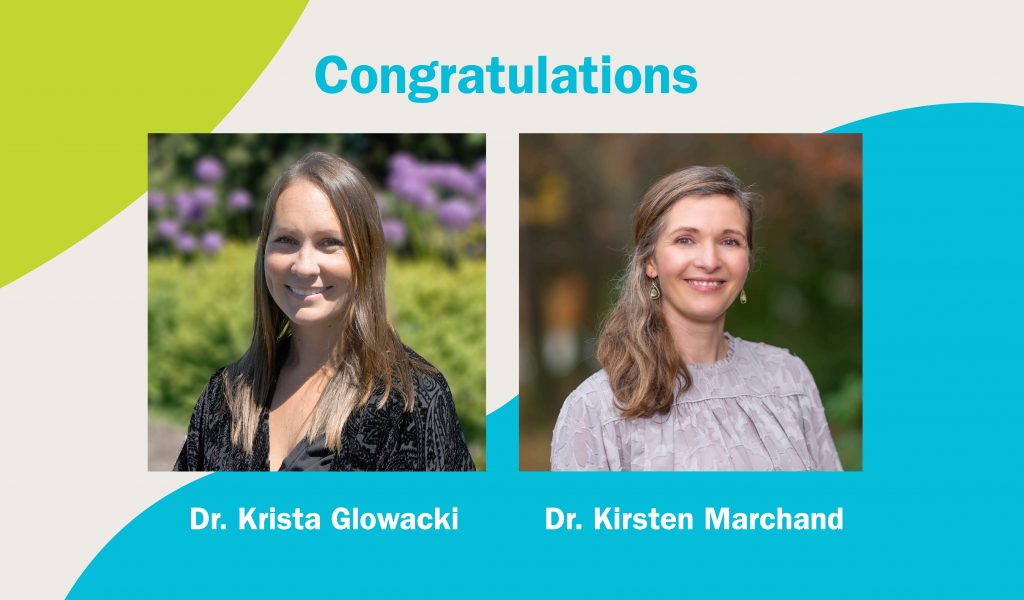
On September 9th, 2021, the Michael Smith Health Research BC (Health Research BC) named Dr. Kirsten Marchand and Dr. Krista Glowacki among the 86 recipients receiving the 2021 Scholar and Research Trainee awards.
The Health Research BC Research Trainee program supports health researchers in the training phase of their research career to enable career development and the long-term success of the BC health research landscape. Dr. Kirsten Marchand and Dr. Krista Glowacki are currently training under the supervision of Foundry’s Director of Research, Dr. Skye Barbic. Learn more about their exciting work with Foundry below:
Dr. Kirsten Marchand
Since 2016, approximately 1,200 youth in BC between the ages of 15 and 24 have died from opioid-related overdoses.
The main goal of Dr. Marchand’s study is to determine how to best help youth who use opioids. To meet this objective, youth, parents/caregivers and service providers will be engaged in a research study, which will explore priorities for opioid use treatment delivery and determine how to best define the benefits of opioid use treatment for youth.
From these findings, service providers and policy makers can deliver opioid treatments in a way that will better meet youths’ unique needs. It will also support future researchers to make sure they are studying what matters most to youth.
“Through my joint appointments at Foundry, the Centre for Health Evaluation and Outcome Sciences, and the University of British Columbia Faculty of Medicine, this award provides a tremendous opportunity to expand my mixed-methods health services research and implementation science skills,” says Dr. Marchand. “This research is essential to inform the co-design and implementation of youth-centered care into substance use treatment services in British Columbia.”
Dr. Krista Glowacki
In Canada, mental health and substance use (MHSU) disorders affect 25% of young people aged 12 to 24 years. The recent global pandemic has exasperated this. Dr. Glowacki’s study will explore how physical activity programming can be offered as a health service through Foundry centres which can be used to manage mental and physical health.
This will be done by using photographs to understand youth needs; developing a working group to consider how to add a service; and, co-creating a physical activity program.
This work will be done collaboratively with diverse youth, service providers and researchers. Dr. Glowacki’s long-term goal is to improve the quality of care and the health of young people with MHSU disorders living in BC, Canada and across the world.
“I am honoured to receive the Michael Smith Health Research BC/Centre for Health Evaluation & Outcome Sciences Research Trainee award to continue to work with Foundry, Dr. Barbic, the research team, and young people”, notes Dr. Glowacki. “Similar to many teenagers today, I dealt with many health challenges. However, through the power of physical activity I was able to take control to manage my mental and physical health, and I’m excited to explore how young people in BC can do the same.”
Congratulations to Dr. Kirsten Marchand and Dr. Krista Glowacki on their awards! With funding support from Health Research BC, we’re excited to see the impact of their research in furthering the delivery of Foundry services as well as contributing to the success of BC’s health research system.
Since our inception in 2015, Health Research BC was one of several organizations who provided critical funding to Foundry. This year, in celebration and honour of Health Research BC’s 20th anniversary, Foundry extends our deep gratitude and appreciation for our continued partnership with the Foundation.
Learn more about Health Research BC Research Trainee program.