Foundry Cariboo Chilcotin – Now Open!
Foundry Cariboo-Chilcotin – Now Open!
We are excited to announce that Foundry Cariboo Chilcotin has opened its doors in Williams Lake – 51, 4th Avenue South!
Foundry Cariboo Chilcotin provides young people ages 12-24 and their families, free and confidential age-friendly services to fit their unique needs, such as drop-in counselling, medical services; including physical and sexual health care, youth and family peer support and social services. Currently, there are 14 Foundry centres open throughout the province with an additional 9 new centres in development.
We congratulate Cariboo Chilcotin Child Development Centre and the numerous community partners who played an instrumental role in bringing Foundry to Cariboo Chilcotin! We are so excited to see Foundry Cariboo Chilcotin officially open its doors and welcome youth and their caregivers.
Read the news release or visit foundrybc.ca https://foundrybc.ca/cariboo-chilcotin-now-open/ to learn more.
Foundry Richmond – Now Open!
Foundry Richmond – Now Open!
We are excited to announce that Foundry Richmond has opened its doors at 101-5811 Cooney Rd!
Foundry Richmond provides young people ages 12-24 and their families, free and confidential age-friendly services to fit their unique needs, such as drop-in counselling, medical services; including physical and sexual health care, youth and family peer support and social services. Currently, there are 13 Foundry centres open throughout the province with an additional 10 new centres in development.
We congratulate Vancouver Coastal Health Authority (VCH), Richmond Addictions Services Society (RASS) and the numerous community partners who played an instrumental role in bringing Foundry to Richmond! We are so excited to see Foundry Richmond officially open its doors and welcome youth and their caregivers.
Read the news release, available in both English and Chinese, or visit foundrybc.ca/richmond to learn more.
Foundry Sea to Sky now offering interim services
Foundry BC receives 2021 Premier’s Award for Innovation
On December 8th, BC Public Services named Foundry BC as the recipient of the 2021 Premier’s Award for Innovation, which recognizes groups, teams or organizations in the BC Public Service who have developed and transformed new ideas into tangible initiatives, programs or projects.
Now, more than ever, we know that young people are in need of support.
Since the launch of A Pathway to Hope in 2019 by the Ministry of Mental Health and Addictions to ensure better access to mental health and substance use for people in BC, more than 12,000 youth accessed Foundry services in more than 90,000 visits. We are thankful Foundry was nominated for this award by our partners in government, and excited to share this acknowledgement with everyone in our network.
“Foundry is a really great example of innovation in the public service because… it’s a model built for youth by youth,” says Nick Grant, Assistant Deputy Minister.
Foundry BC is incredibly honoured to be part of this annual celebration which highlights the finest examples of innovation and excellence in the BC Public Service. Thank you to all Foundry centres and networks across the province who are instrumental in this achievement, as we continue our mission in reaching younger people early and address smaller problems before they become bigger ones.
To learn more, watch the video below.
Visit foundrybc.ca or Foundry Virtual BC to learn more about our services.
Keywords:
BC Public Service, Foundry BC, Foundry Virtual BC, 2021 Premier’s Award for Innovation, Award, Mental Health, Public Service, Youth, Youth Services, British Columbia, Support, Youth Support, Support Services, Provincial Services, BC, Nick Grant, Dr. Steve Mathias, Peer Support, Counselling, Caregivers, Parents, Innovation, Substance Use, A Pathway to Hope, Ministry of Mental Heath and Addictions, Michael Smith Health Research BC, Providence Health Care, St. Paul’s Foundation
Learnings from the first year of Foundry Virtual BC
Since the COVID-19 pandemic began, many children and youth in BC are experiencing increased anxiety, stress and other mental health challenges. Foundry has worked quickly to implement innovative virtual solutions for youth and families/caregivers living in BC (learn more in this overview of Foundry’s COVID-19 response to date).
Last spring, we launched virtual services using interim technology, and in early April 2020, Foundry Virtual BC began offering services to young people and families/caregivers across the province through the Foundry BC app, which was co-created with and for youth.
The app offers a user-friendly, accessible way to schedule virtual counselling and peer support appointments in advance, as well as access same-day support via messaging, audio or video sessions, peer group sessions, and web-based tools and resources. No referrals or assessments required.
Here are some of our learnings one year later (taken from Frayme’s report):
- Foundry’s provincial virtual service filled a gap for youth and their families/caregivers who otherwise may not have accessed services.
- The soft launch of the Foundry BC app has already changed the way youth and families/caregivers access services virtually in BC.
- Breaking down barriers to access and advancements in technology have led to increased youth engagement with Foundry Virtual BC.
- With the rapid launch of Foundry Virtual BC, youth in BC have been able to access multiple services to address their needs and improve their outcomes.
- Foundry’s provincial virtual service is reaching high risk and high-needs youth across BC.
- BC youth and families/caregivers are having positive experiences with Foundry Virtual BC technology, services and staff.
- Foundry’s provincial virtual service team has gained valuable insight for quality improvement opportunities and innovations in virtual care.
Since launching virtual services, Foundry has received positive feedback from youth.
“My peer supporter really knows me by now and is able to make really personalized suggestions.”
“I was diagnosed with a disorder that now allows me to begin receiving treatment.”
“It allowed me to talk about how I was feeling, ask for coping mechanisms, and say personal things.”
Foundry Virtual BC offers virtual counselling sessions by voice, video and chat (including booked appointments and walk-ins); peer support (including one-on-one services and peer lead groups); and groups and workshops for young people and their families/caregivers.
The Foundry BC app is available through the Apple Store, Google Play store or on desktop through a web portal.
To learn more and access services, visit foundrybc.ca/virtual.
Keywords: mental health, anxiety, stress, peer support, counselling
Beauty of Life in Psychosis (BLIP): Challenging the definition of “normal”
In *our previous article, Discovering the Beauty of Life in Psychosis, we introduced the first ever BLIP cohort and shared some of the amazing art created by our peers in the group. We’re excited to share some of the insights and artwork from the second cohort of BLIP, which ran over the course of this summer.
First, a quick recap: what is Beauty of Life in Psychosis (BLIP), anyway?
Beauty of Life in Psychosis (BLIP) is an art and creativity group for young people who self-identify as experiencing psychosis, hearing voices, seeing visions and/or having unique beliefs (VVUB). BLIP is a peer-led group, which means that the facilitators (that’s us – Rory and Anne!) have had similar experiences.
The group was born out of a simple idea: that we deserve safe(r) spaces to socialize, be part of a community, talk about our experiences and express ourselves creatively, all without fear of judgment.
Now, in partnership with Vancouver Coastal Health’s Consumer Initiative Fund, Foundry Virtual BC and Early Psychosis Intervention BC, as well as support from The Paint Spot, we’ve been able to host two successful cohorts – including providing all group members with free art supplies.
The goal of BLIP
The goals of BLIP are to build a sense of belonging, normalize talking about VVUB/psychosis and make space to explore and express the personal meaning of our experiences.
In developing BLIP, it was important for us to recognize that while VVUB/psychosis can be confusing, frightening and difficult, it can also be a “normal” part of life with all the complexity of any other parts of life. VVUB/psychosis can also be funny, annoying, boring, interesting, inconvenient, exciting, frustrating, pleasant, ugly and/or beautiful.
We want to treat VVUB/psychosis as an experience that is part of the unique and valuable perspective we are able to share with the world.
Challenging the definition of “normal”
It only makes sense, that the theme the group chose to focus on was “normalcy”. The group questioned the idea of a single definition of “normal,” pointing out that what’s normal for one person might not be for another person, with an emphasis on the importance of knowing our own minds, bodies and needs best. We discussed who gets to decide what counts as “normal,” and how the pressure to be “normal” can be stigmatizing, isolating or feel like having to wear a mask.
On the other hand, we also talked about how “normal” can be a reassuring reminder of what’s common and expected, helping to ground us in reality. We talked about wanting to be seen as “normal” instead of being treated differently and, on the other hand, the desire to reject being “normal” and reclaim being different, embracing the value of our diverse experiences.
Sharing experiences through art
As a group, we found that some of these experiences are easier to communicate through art rather than words, particularly ones “normal” to us but unfamiliar to others. We also found that even though we all had different definitions of “normal” and different relationships to the concept, one way to feel normal was through being in community with each other: by finding commonality in difference.
We invite you to reflect on how the theme of normalcy comes through in the following works by BLIP artists. We are thrilled to share the artwork created with the first cohort of the BLIP youth group.
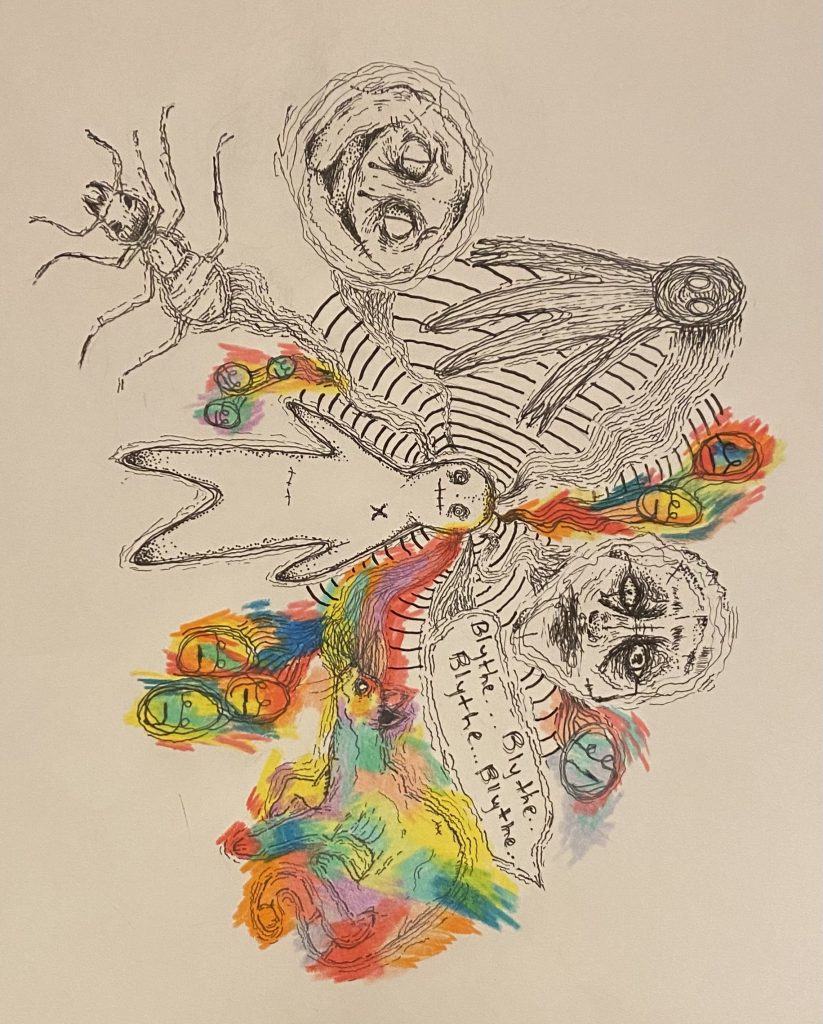
Permanent Fever Dream, 2021 Blythe
About the artist: Blythe is a 20 year old individual diagnosed with schizoaffective disorder. She enjoys creating art that depicts her hallucinations and experiences with psychosis, as well as animal portraits. Her favourite mediums to work with are ink, coloured pencil and oil paint.
Artist statement: This drawing in ink and coloured pencil depicts common themes found in my hallucinations. I wanted to capture how, for me, these experiences often labelled “abnormal” can be frightening but also very captivating & interesting. I used bright colours to show which of these visions I perceive as friendly and intriguing.
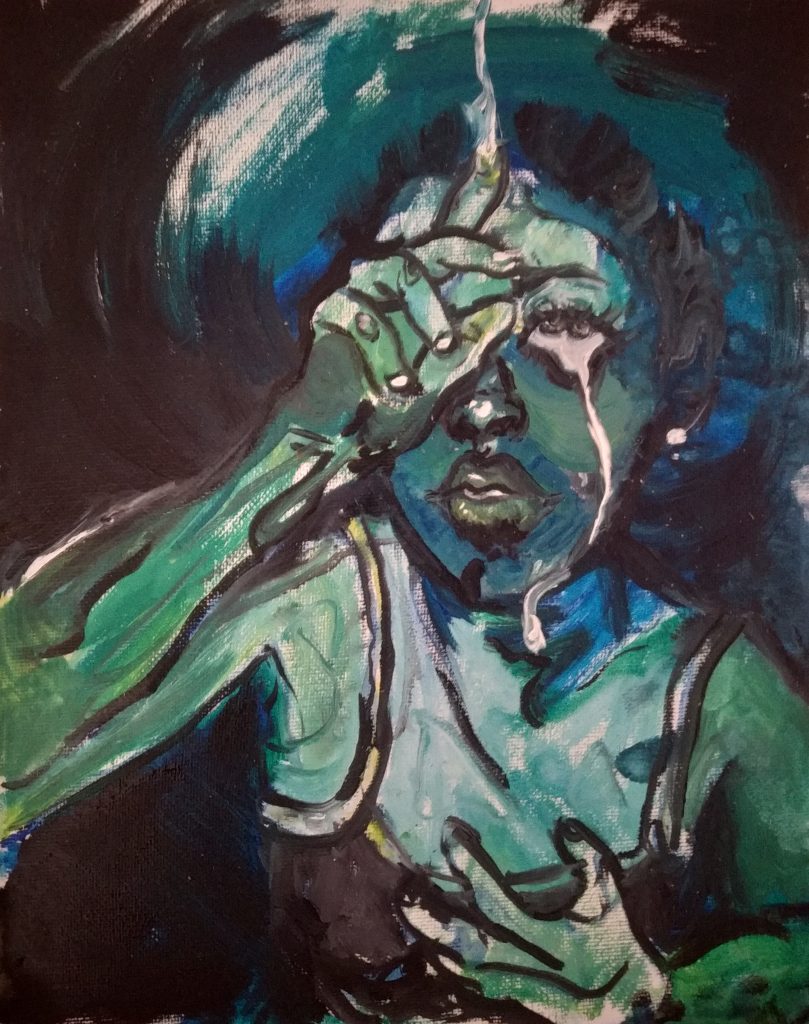
Self Portrait, 2021 Heart
About the artist: Heart experiences psychosis and uses her art to express her unique beliefs surrounding divinity and fate.
To learn more about future offerings of Beauty of Life in Psychosis (BLIP), or to learn more about groups offered by Foundry’s provincial virtual services, please visit foundrybc.ca/virtual/youth-groups.
To learn more about psychosis read the Questioning Reality section of our website or take the Questioning Reality Self-Check. If you would like to reach out to Foundry for support, reach out to Foundry’s provincial virtual services or visit a Foundry centre near you.
*Note about the authors:
Anne (she/they) is a cat parent and casual peer support worker at Foundry Virtual BC with lived/living experience with voices, visions and unique beliefs, and psychosis. They are also a group facilitator for the BC Hearing Voices Network, Kaleidoscope and a researcher in early psychosis. They enjoy incorporating art and writing into their life as well as keeping active and being outdoors.
Rory (they/them) is a non-binary artist, peer support worker and researcher with lived/living experience of psychosis. They are also a facilitator and administrator for the BC Hearing Voices Network, and their writing on the Hearing Voices Movement recently appeared in Health and Human Rights Journal.