Foundry Surrey Secures a Location
Celebrating Beauty of Life In Psychosis (BLIP): A Retrospective
In the last two articles Anne Liao and I wrote about Foundry’s Beauty of Life In Psychosis (BLIP) group, Discovering the Beauty of Life In Psychosis and Beauty of Life In Psychosis (BLIP): Challenging the Definition of “Normal”, we reflected on our experiences co-facilitating the first two cohorts and shared some of the amazing artwork and insights from the group. Now, as this year-long project draws to an end, we’d like to wrap things up with a celebration of our third and final cohort.
First, a little bit of background information about BLIP: Beauty of Life in Psychosis (BLIP) was an art and creativity group for young people who self-identify as experiencing psychosis, hearing voices, seeing visions, and/or having unique beliefs. BLIP was fully peer-led, which means that it was dreamed up, developed, and facilitated by people with these experiences – Anne and myself. Our concept for the group was simple: we wanted to create a safe(r) space to socialize, be part of a community, talk about our experiences, and express ourselves creatively, all without fear of judgment. We were able to host three six-session cohorts of the group, including supplying all participants with free art supplies, in partnership with Vancouver Coastal Health’s Consumer Initiative Fund, Foundry Virtual BC, and Early Psychosis Intervention BC (EPI).
With BLIP, we hoped to challenge some of the stigmatizing ideas that exist around psychosis and unusual perceptions like hearing voices. We wanted to normalize speaking openly about our experiences in all their complexity, as a “regular” part of life and the spectrum of human experience – something that can be funny, scary, weird, interesting, or sometimes beautiful. We aimed to create a space where people felt able to explore their/our experiences in art and discussion, because often, there aren’t many opportunities to share these important conversations with other people. We wanted to recognize the value of the unique perspectives that everyone brought to the group, while also thinking about how the group could be a collaborative space to learn from each other and bounce ideas back and forth. With that in mind, for each cohort, we also worked together as a to come up with a final, themed group project.
For the first two cohorts, our themes were “transformation” and “normalcy.” For the third cohort, the theme we settled on was “societal expectations.” The theme was deliberately open-ended, because we felt that it encompassed many sub-themes that we were interested in as a group. Some of the sub-themes we discussed were experiences of stigma and the expectation to conform; the expectation to “fit into categories”; expectations, assumptions, and judgments around “functioning” and “functioning levels”; and the challenge of finding your own authentic identity. Overall, the group painted a picture of the complexity of navigating societal expectations and identity as young people living with psychosis, voices, visions, and unique beliefs. Many of the sub-themes we discussed in this cohort weren’t specific to psychosis or mental health – instead, some were more about growing up and finding ourselves as people. After all, these experiences are only one aspect of our lives, woven into other, larger stories.
Stay tuned in the new year for artwork from this cohort, which we’ll be sharing on Foundry BC social channel and ware looking to organize a combined exhibition of work by artists from all cohorts. Thank you to all the amazing artists who participated and to our partners at Foundry VIrtual BC, Vancouver Coastal Health and Early Psychosis Intervention BC (EPI) for helping make this group possible!
Note about the author:
Rory (they/them) is an artist, peer support worker and researcher with lived/living experience of psychosis. They are the coordinator for the BC Hearing Voices Network and currently study psychosis in cultural context at the UBC School of Social Work. They draw heavily on their experience of psychosis in their practice as an acrylic painter.
Coast Capital Education Bursaries
Foundry has partnered with Coast Capital to support their 2024/2025 Education Bursaries
These bursaries recognize individuals who have stayed committed to their education, even through adversity. Whether it’s financial difficulties, family issues, personal loss, lack of supports, or health challenges, the Coast Capital Education Bursaries can support youth in building a better future. These awards and bursaries are available to youth participating in the Foundry Work & Education Program and are intended to help youth pursue and achieve their education goals. They may be put towards tuition, enrolment fees, or used to help overcome other challenges to pursuing education goals.
For 2024/2025, we’re offering the following:
Coast Capital Bursaries
- Foundry centres offering the Foundry Work & Education Program will be eligible to offer youth a $1000-$2000 bursary.
- The initial limit will be up to $6000 per centre on a first come first service bases.
Eligibility
To be eligible to receive one of the Coast Capital Education Bursaries, youth must be:
- Currently participating in the Foundry Work & Education Program
- A Canadian citizen or permanent resident;
- A resident in BC for at least six months;
- 24 years of age or younger
- Planning to pursue any type of studies to further educational/ career goals.
*Individuals who have delayed starting or are resuming their post-secondary studies/Adult Graduation diploma are welcome to apply.
Application
- Bursary applications are now open and will be accepted on an ongoing basis – Connect with an Employment Specialist at your local centre to apply!
If you have any questions about the awards or application process, please contact FWEP@foundrybc.ca


Kamloops Residential School Response
Trigger warning: Residential Schools
Foundry is deeply devastated to learn that remains of 215 children were found on the grounds of the Kamloops Indian Residential School. So many children were taken from their families from many Nations and communities as a result of the residential school system. We keep all of those who did not have a child return home, as well as the survivors of residential schools, in our hearts today and always.
We extend our thoughts to the Tk’emlups Secwépemc First Nation and all of the Indigenous communities, Nations, families and youth who have been affected by this tragic discovery.
This news impacts Indigenous Peoples in ways that bring forward unimaginable trauma. We encourage survivors and family members to reach out for support. We thank the First Nations Health Authority for calling on health partners to mobilize supports for the Tk’emlúps community and others as circumstances unfold.
Here are supports and services available to those who need it:
- National Indian Residential School Crisis Line: 1 866-925-4419
- KUU-US Crisis Line: 1-800-588-8717
- Tsow-Tun-Le-Lum Society: 1-888-403-3123 or 250-390-3123
- Indian Residential School Survivors Society: 604-985-4464 or 1-800-721-0066
We honour the children whose lives have been lost at the hands of colonization, residential schools and incomprehensible violence. They are not forgotten, and we must keep all of them in our work every day.
-Foundry’s Indigenous Wellness team
New mobile unit provides greater access to mental health and substance services for Central Okanagan youth
Discovering Beauty of Life In Psychosis (BLIP)
About the authors
Rory (they/them) is a non-binary artist, peer support worker, and researcher with lived/living experience of psychosis. They are also a facilitator and administrator for the BC Hearing Voices Network, and their writing on the Hearing Voices Movement recently appeared in Health and Human Rights Journal.
Beauty of Life in Psychosis
Rory and Anne, have had the pleasure of developing the Beauty of Life in Psychosis (BLIP) group, nurturing it through its infancy, and facilitating the first ever cohort over the last 3 months. It has been an amazing experience getting to know our peers in the group, whom have all brought with them a plethora of skills, experiences, stories, talents and creative ideas.
Breakthrough symptoms or relapse of psychosis are sometimes referred to as “blips.” But what is a blip, anyway? Colloquially, a blip is a minor, short-term change, like a small dip or spike on a graph. “BLIPS,” on the other hand, is a medical term that stands for “Brief Limited Intermittent Psychotic Symptoms.” Foundry’s provincial virtual services offers a youth group called BLIP using our own definition: Beauty of Life in Psychosis.
Sometimes, psychosis is talked about in stigmatizing ways that make people feel like they are broken, abnormal, or “crazy.” Foundry Virtual BC hopes to reclaim the word “blip” to mean something that- while can be frightening or upsetting– can also be a common, experience. Psychosis is complicated, and we believe it’s important to be able to speak openly about what it means for each of us individually – the good, the bad, and the beautiful! Through art and creativity, we hope to build a sense of connection and community, explore the personal meaning of our experiences, and celebrate ourselves as whole people with a unique, beautiful perspective to contribute to the world.
The BLIP youth group was born out of the idea that people who experience psychosis, hear voices, see visions, and/or have unique beliefs need a safe(r) space to socialize, get creative, and express ourselves. Our goal is to encourage participants to find beauty, hope, and community within or around these experiences. With support from Foundry Virtual BC and Vancouver Coastal Health’s Consumer Initiative Fund, that idea became a reality. Using these funds, we were able to collaborate with Paint Spot and provide free art supplies for everyone in the group.
We started each session with a short, guided exercise surrounding a specific theme. Over the course of 6 sessions, we explored self-expression, colour, movement, texture, light & dark, and lastly, space. During the final few sessions, we discussed our ideas for the final project as a group, and the theme we settled on was “transformation.” We spoke about journaling our experiences and growing through that process; imagining and pursuing futures for ourselves that we were told not to expect, the transformation of our self-perception throughout our journeys; and how media portrayals can “transform” our experiences and identities in stigmatizing ways. In that sense, we talked about both negative and positive transformations. Sub-themes of renewal, growth, uncertainty, healing, and the shattering (and rebuilding) of identity emerged.
We are thrilled to share the artwork created with the first cohort of the BLIP youth group. Click on images to expand!
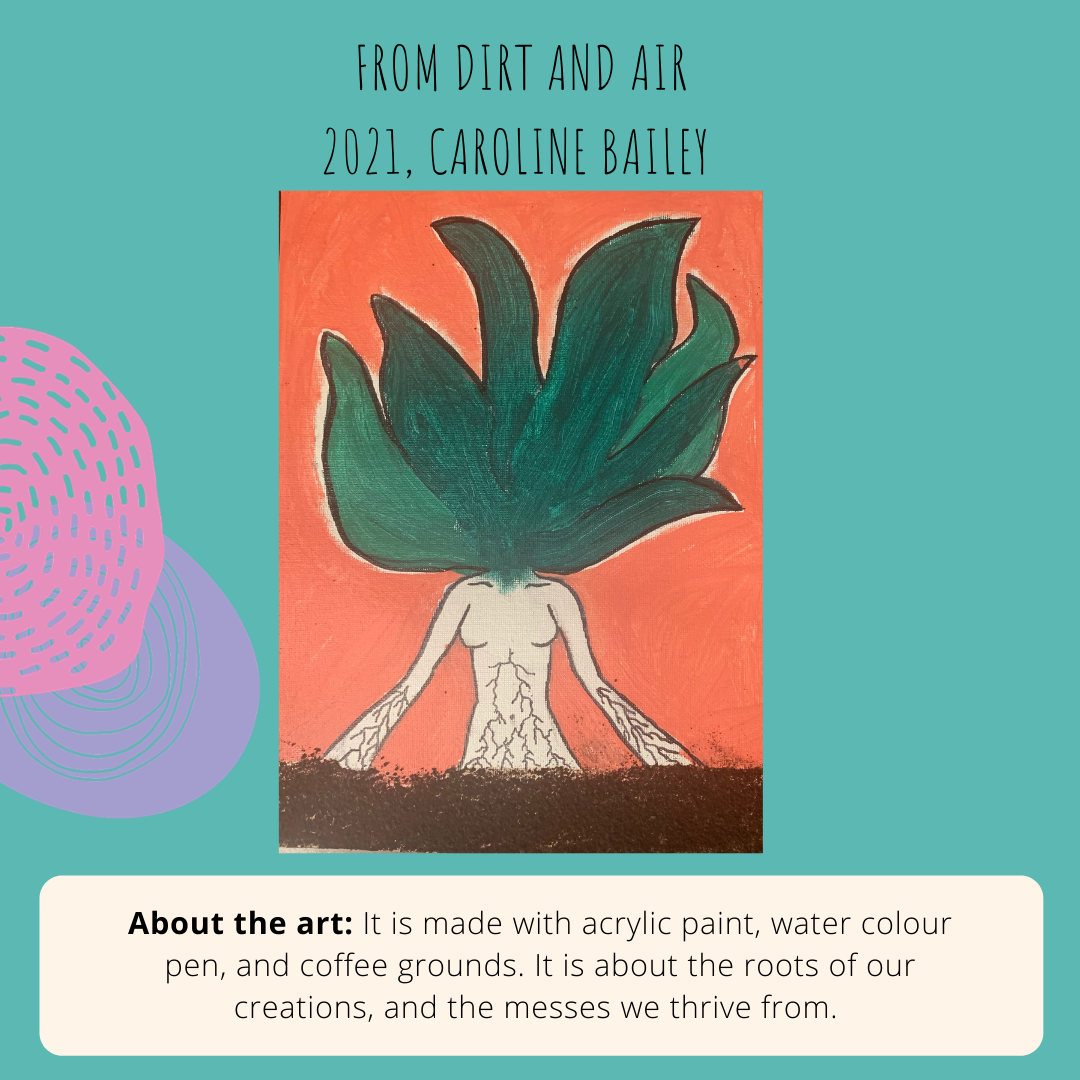
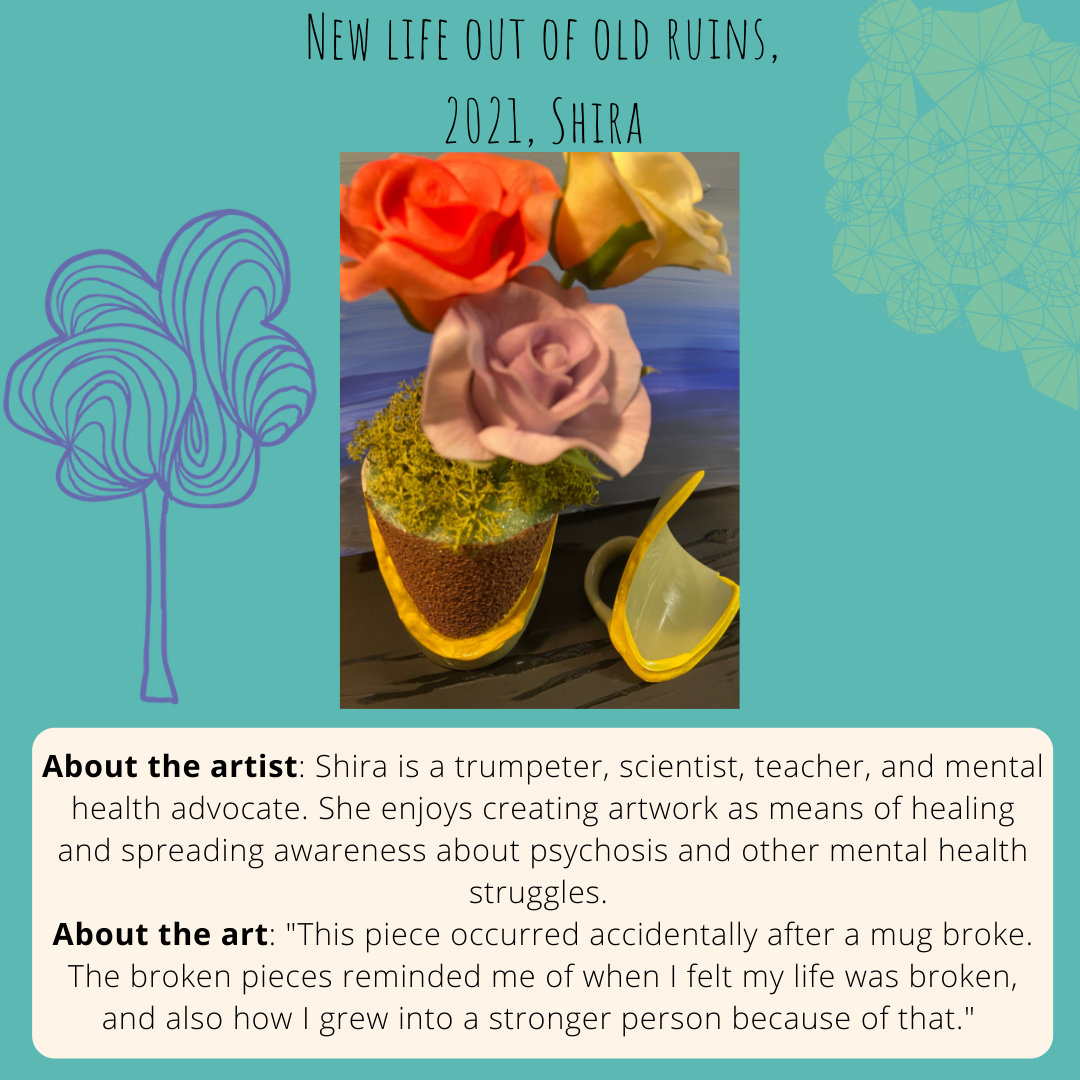
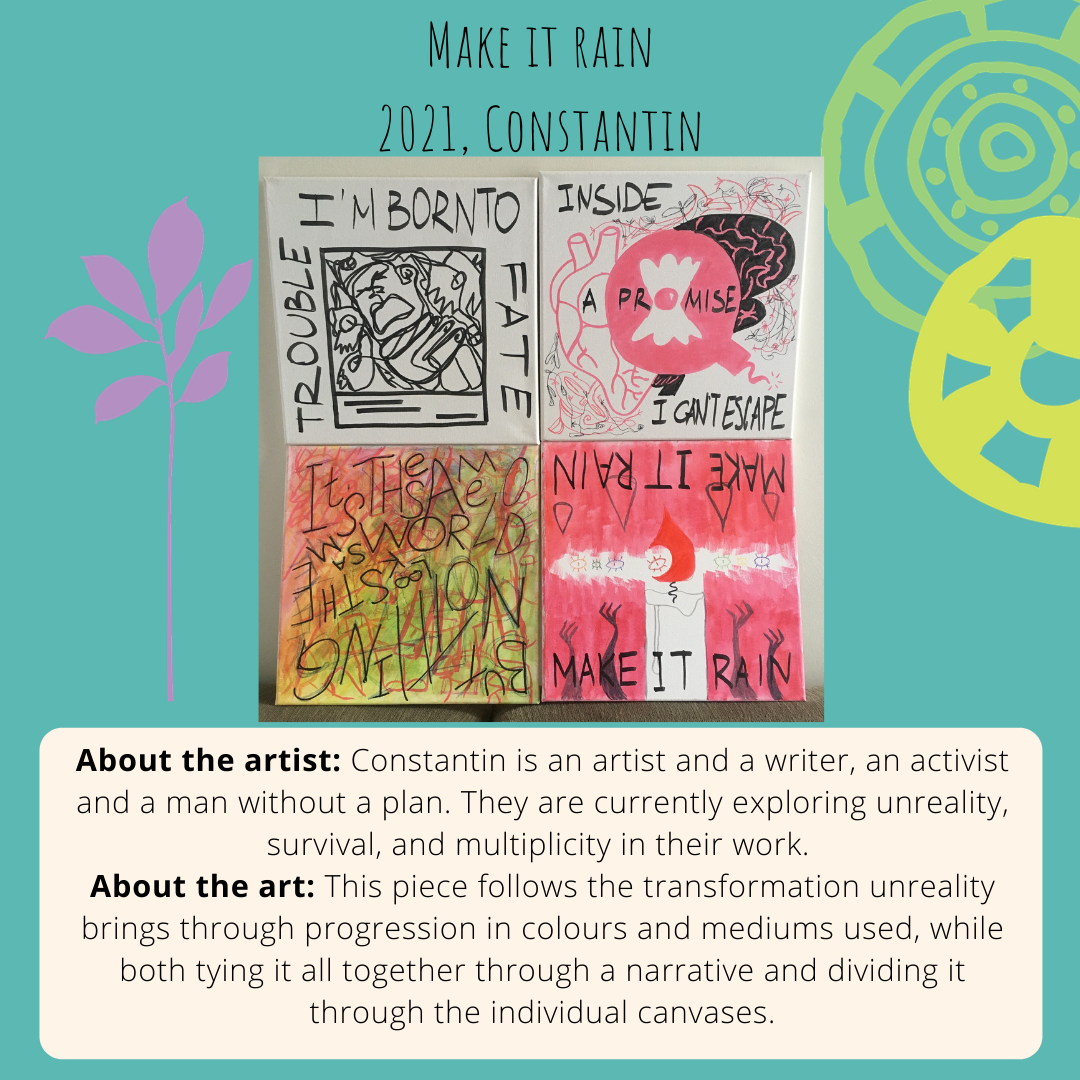
To learn more about future offerings of BLIP, or to learn more about groups offered by Foundry’s provincial virtual services, please visit foundrybc.ca/virtual/youth-groups.
To learn more about psychosis read the Questioning Reality section of our website or take the Questioning Reality Self-Check. If you would like to reach out to Foundry for support, reach out to Foundry’s provincial virtual services or visit a Foundry centre near you.
New Foundry BC app transforms access to vital services for youth & caregivers
Introducing Foundry Works!
This week, in celebration of national Mental Health Week, the BC Government and Future Skills Centre & CAMH announced their support of Foundry Works! This new supported program will provide flexible, wrap-around services to help youth who are currently not in education, employment or training to succeed in school, find a job and meet their own personal goals. At Foundry, we believe all young people should have access to meaningful education and employment opportunities. Through this program, Foundry will support young people by coordinating and aligning their health, wellness and education/employment goals.
Beginning this summer, Foundry Works! will be available in the following Foundry centres: Abbotsford, Kelowna, North Shore, Prince George, Ridge Meadows, Terrace, Vancouver-Granville, Victoria, Richmond, Campbell River and Penticton. In addition, young people will be able to access Foundry Works! virtually through the Foundry BC app.
Watch foundrybc.ca for updates regarding this exciting new program.